Concentration, Correlation and Shared Dependencies
Section 1 of 4
Concentration and custody exposure
Your learning goal
Assess combined exposure beyond the number of assets held.
A portfolio can contain many asset names while relying on one exchange, stablecoin or bridge. Diversification requires examining both price relationships and operational dependencies. This lesson builds a stress worksheet that looks beyond the number of holdings and keeps assumptions about correlation modest.
Key idea
Count the shared dependency behind each apparently separate holding.
Education only. Crypto assets can lose substantial value or become worthless. No lesson requires buying an asset, depositing money or sharing real passwords, private keys or recovery words.
Watch concentration grow on its own
A farmer in Mendoza, Argentina, plants half her field with grapes and half with olives. If the vines grow wildly, by autumn they shade most of the field, though she planted nothing new. Portfolios drift the same way.
Investor.gov, the US Securities and Exchange Commission's education site, sums up diversification as "don't put all your eggs in one basket", across types of investment and within each type. In crypto, a rise in one token can make it dominate your holdings without any new purchase.
Spreading money across many tokens looks like the answer. But crypto adds a twist: different baskets often fall at the same time.
Map the hidden exposures
A house in Frankfurt can be well built and still flood, burn or be burgled, and each risk needs a different defence. A crypto holding is similar: price is one risk, and where and how it is held add others.
| Exposure | What can go wrong | Where you studied it | Question to ask |
|---|---|---|---|
| Price and correlation | Many assets fall together | This lesson; Level 7 | If bitcoin fell 50%, what would my total lose? |
| Stablecoin | Loses its peg; reserves frozen | Level 3 | Which stablecoins do I hold, and how much in each? |
| Exchange or lender | Withdrawals paused; insolvency or fraud | Level 3 | How much sits with any single provider? |
| Custody | Lost keys, lost backup, theft | Level 2 | Who holds the keys, and is the backup tested? |
| Smart contract and bridge | Bug, exploit, admin-key abuse | Levels 4 and 6 | Which contracts hold my money right now? |
| Chain | Outage or attack on the network | Levels 1 and 4 | Is everything on one network? |
Writing your holdings against this table often reveals surprises. The next two sections look at the layers that most often catch people out.
Check stablecoin custody and exchange concentration
A traveller in Paris who keeps cash, cards and passport in one bag has turned one theft into a disaster. Spreading them across pockets doesn't stop theft, but it limits what one theft can take.
Stablecoins aim to hold a peg, but they are not promised to and are not bank deposits. On the evening of 10 March 2023, Circle, the issuer of USDC, announced that US$3.3 billion of its reserves sat at the failed Silicon Valley Bank; Chainalysis puts that at about 8% of USDC's backing. By 2am on 11 March, USDC had dropped to US$0.87, and by the time of Chainalysis's report on 16 March it had regained its peg. Anyone holding only USDC saw a 13% paper loss over a weekend.
Exchange concentration works the same way. Level 3 showed how FTX collapsed in November 2022, and how customers of failed platforms such as Mt. Gox and Celsius faced slow, partial and uncertain recoveries. Custody is the mirror image: moving everything to one self-custody wallet removes exchange risk but puts it all behind one seed phrase backup.
Providers and stablecoins are visible names on a statement. Code is less visible, and that is the next layer to map.
For example, three tokens on one network may use the same stablecoin quote and sit at the same exchange. Their price charts can differ while withdrawal risk remains shared. Adding another token at the same custodian may change asset weights without reducing custody concentration.
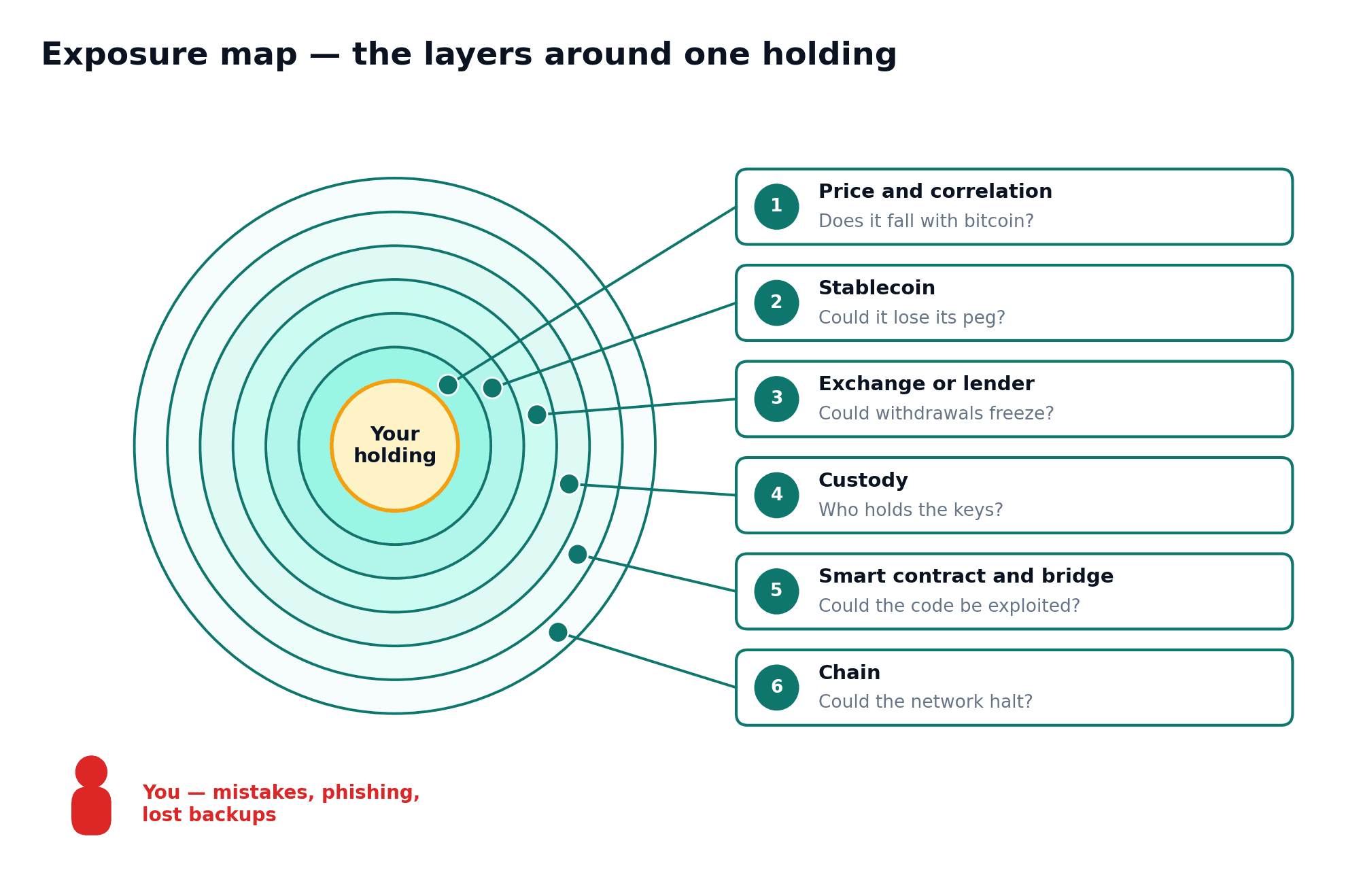
Read diagram as text
Price and correlation: does it fall with bitcoin? Stablecoin: could it lose its peg? Exchange or lender: could withdrawals freeze?
Custody: who holds the keys? Smart contract and bridge: could the code be exploited? Chain: could the network halt?
The separate user warning lists mistakes, phishing and lost backups. These exposures can overlap.
Section 2 of 4
Correlation and shared dependencies
Several names can share the same storm
Picture ten fishing boats in Incheon that all leave on the same morning. Different boats, different crews, but one storm reaches all of them. Owning ten crypto tokens can be like owning ten boats in the same storm.
Many crypto assets have tended to move with bitcoin, and in sell-offs they have often fallen together: in 2022 the whole market shrank by roughly 70%, not one or two coins. Crypto can also move with shares. An International Monetary Fund (IMF) blog from January 2022 found that the correlation between bitcoin and US S&P 500 returns rose from 0.01 in 2017–19 to 0.36 in 2020–21, and that spillovers grew during market turmoil.
So treat most crypto holdings as one connected exposure to "crypto market risk", and size the total accordingly. Price is only one exposure, though; the next ones don't show on a chart.
Positive correlation means the measured returns tend to move together under that sample; it is not a permanent law. A pair with different past trends can still fall together when financing or confidence weakens. A low estimated correlation also does not capture a common operational failure, such as a frozen custodian.
Trace shared chains contracts bridges and issuers
Map where assets are held, which tokens provide quote or collateral value, and which applications rely on the same bridge or oracle. A bridged representation can connect several positions to one mechanism. A liquid-staking token used across protocols can propagate a common redemption or price disruption. Different websites may be separate interfaces to shared infrastructure.
Assign amounts to each dependency without pretending overlapping exposure categories must add to 100 percent. The same USD 1,000 position can count toward asset, custodian and bridge concentration simultaneously. State the purpose of each total. This avoids double counting in portfolio value while still showing multiple risk channels. A dependency total is an exposure view, not another holding to add to wealth.
| Holding | Starting value | Supplied shock | Value after shock |
|---|---|---|---|
| BTC exposure | USD 4,000 | Negative 30 percent | USD 2,800 |
| Token A | USD 3,000 | Negative 50 percent | USD 1,500 |
| Stable B | USD 3,000 | Negative 10 percent | USD 2,700 |
| Total | USD 10,000 | Record your notes and evidence here | USD 7,000 |
No execution, tax or additional costs assumed. Custodian suspension would affect access separately from these market values.
Section 3 of 4
Policy boundaries, stress tests and recovery
Set explicit policy boundaries
A written policy can specify maximum hypothetical exposure by asset or dependency, review intervals and rebalancing conditions. The boundaries should fit the exercise's stated purpose and constraints, rather than follow a universal allocation formula. Include what happens when a price change breaches a limit and whether liquidity or tax considerations affect the response.
Separate normal review from emergency response. A market-weight drift, a custodian suspension and a key compromise need different actions. Define observable triggers and the information required before acting. A policy cannot force market execution, but it can stop emotional improvisation from changing the rules unnoticed. Record any exception and its rationale so the reviewer can compare the action with the original boundary.
Stress prices access drawdown and recovery
Use a fictional USD 10,000 portfolio: USD 4,000 BTC exposure, USD 3,000 Token A and USD 3,000 Stable B. A 30 percent BTC fall, 50 percent Token A fall and 10 percent stablecoin depeg leave USD 7,000 before costs. The USD 3,000 loss is 30 percent of starting value. A simultaneous withdrawal suspension can prevent the planned rebalance.
Drawdown measures a decline from a prior equity peak to a subsequent lower value. Recovery arithmetic uses the reduced base: a 30 percent fall requires about 42.86 percent growth to return to the original value, ignoring cash flows. PipStart's Drawdown Calculator and Gain Recovery Calculator illustrate these relationships, not recovery probability. Reconcile deposits and withdrawals before interpreting an equity series. The next lesson adds purchase schedules, exits and records.
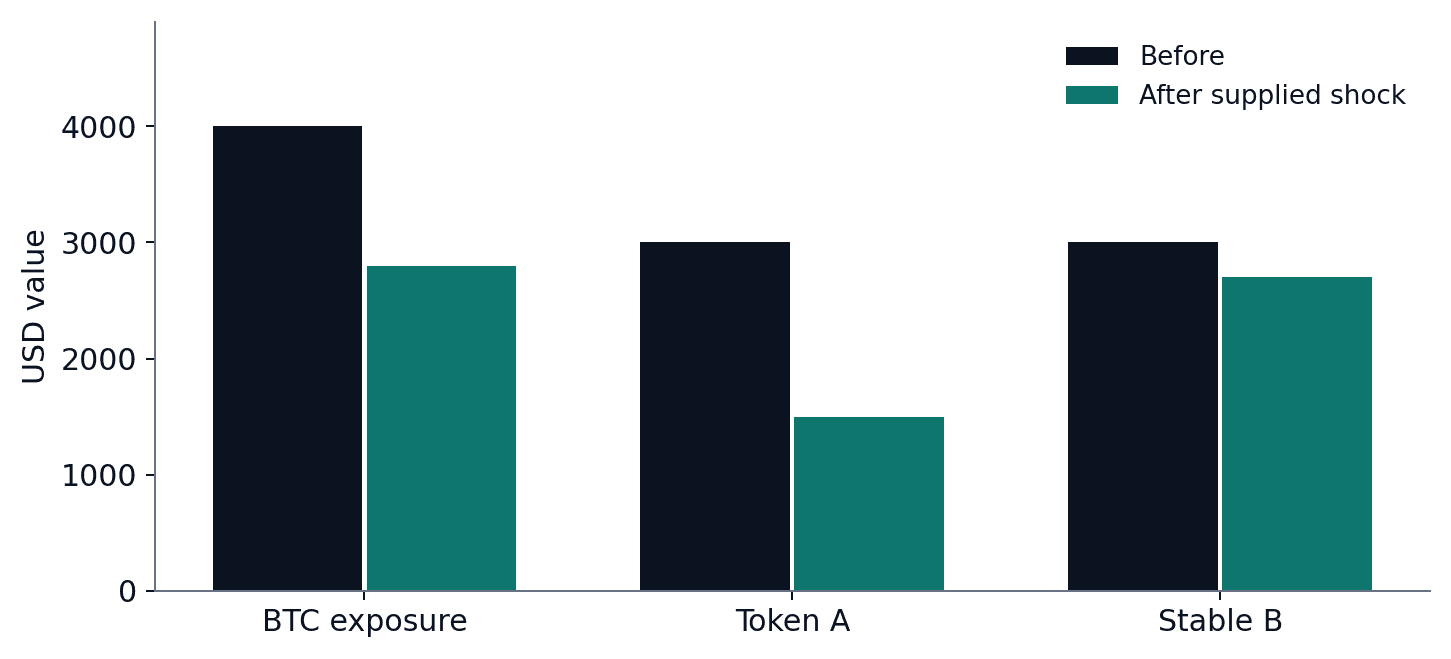
Read diagram as text
BTC exposure falls from USD 4,000 to USD 2,800. Token A falls from USD 3,000 to USD 1,500. Stable B falls from USD 3,000 to USD 2,700.
The total falls from USD 10,000 to USD 7,000 before costs.
An access suspension is a separate stress: a displayed market value does not establish the ability to withdraw.
Section 4 of 4
Everyday example, practice and review
Try the following questions aloud or on paper before opening the worked answers. Compare your reasoning as well as your final answer.
Try it yourself
Try each question on paper or explain your answer aloud before opening the worked answers. This practice is for learning; it is not scored.
1. Calculate the percentage loss in the USD 10,000 to USD 7,000 scenario.
2. What gain returns USD 7,000 to USD 10,000?
3. Explain why the same holding can appear in more than one dependency category without being added twice to portfolio value.
Compare with the worked answers
Worked answers
1. USD 3,000 divided by USD 10,000 equals 30 percent.
2. USD 3,000 divided by USD 7,000 equals about 42.86 percent. It is arithmetic, not a recovery forecast.
3. Dependency views describe different failure paths for the same exposure. They are not additional assets and must not be summed as wealth.
Quick knowledge check
Try each question on paper or explain your answer aloud before opening the worked answers. This practice is for learning; it is not scored.
Does holding five tokens guarantee diversification against an exchange suspension?
Compare with the worked answers
Worked answers
No. If all are held at the same provider, access can be concentrated despite different asset names.
What to remember
✓ Price and operational concentration need separate views.
✓ Correlation depends on the sample and can change.
✓ Stress tests should include blocked exits as well as falling prices.
Lesson completion check
References and further reading
References
SEC Investor.gov: Crypto Asset Custody Basics for Retail Investors ↗
Glassnode: Exchange Data Transparency Notice ↗
CFTC: Understand the Risks of Virtual Currency Trading ↗
Financial Conduct Authority: Financial Conduct Authority — Cryptoassets ↗