DCA, Rebalancing, Exits and Useful Records
Section 1 of 4
Recurring purchases, fees and average cost
Your learning goal
Compare a recurring-purchase plan and maintain a record that explains the outcome.
A recurring purchase schedule can make a process easier to follow, but it cannot make a poor asset safe. Rebalancing and exits also require rules, liquidity and records. This lesson calculates a simple DCA schedule, examines cash-out planning and explains the information needed to distinguish market results from deposits and transfers.
Key idea
Keep a ledger that can explain every change in units and account value.
Education only. Crypto assets can lose substantial value or become worthless. No lesson requires buying an asset, depositing money or sharing real passwords, private keys or recovery words.
What recurring purchases change
Choose how money goes in
A parent in Guadalajara can buy all the school uniforms in January, or one piece a month as money comes in. Either way the family ends up with uniforms; what changes is when the money is spent, and how she feels if prices move meanwhile.
Putting money into crypto raises the same question. You can invest a lump sum, the whole amount at once, or spread it out in equal parts over time. The second approach has a name.
The sizing and exposure lessons in Level 8 still apply: whichever method you choose, the total must fit your loss budget. DCA changes the timing of purchases, not the risk of the asset, as the numbers show.
Weigh DCA against a lump sum honestly
Suppose the price had risen steadily instead: ¥500, ¥600, ¥700, ¥800, ¥1,000 (invented). Haruto's ¥10,000 a month would buy about 20, 16.7, 14.3, 12.5 and 10 units, about 73.5 in total, worth about ¥73,500 at the end. A lump sum of ¥50,000 in month 1 would have bought 100 units, worth ¥100,000. When prices rise, waiting costs money.
Which path is more common? Nobody knows for crypto. One widely cited study comes from traditional markets. In February 2023, Vanguard researchers Megan Finlay and Josef Zorn compared investing a lump sum with spreading it over time for balanced stock-and-bond portfolios. They found lump-sum investing beat cost averaging roughly two-thirds of the time, with similar results in the US, UK, Canada, Australia and Europe. Their explanation: money waiting in cash misses whatever the market earns in the meantime.
The same research gives DCA its fair due. Cost averaging temporarily lowers risk and can limit the damage if prices fall soon after you start, which helps people who would deeply regret a badly timed lump sum. Vanguard's guidance for investors puts it this way: DCA offers emotional comfort and less timing regret, at the likely cost of lower returns in a rising market.
So DCA is a choice about regret and discipline, not a way to beat the market, and it has a cost that grows when amounts are small.
Count the fees on every purchase
A commuter in Calgary who tops up a transit card in tiny amounts, paying a flat charge each time, loses a bigger share to charges than someone who tops up monthly. DCA with fixed fees works the same way.
Fee as a percentage of each purchase = fee ÷ purchase amount × 100Getting money in is one decision. Over time your holdings drift from the plan, which needs a second.
It spreads entry timing but does not ensure a favourable average relative to future value.
Calculate average cost using total units
Suppose GBP 200 is spent on each of three dates at GBP 20, GBP 25 and GBP 10 per unit, ignoring fees. The purchases acquire ten, eight and twenty units, giving 38 units at a total cost of GBP 600. Average cost is GBP 600 divided by 38, or approximately GBP 15.79 per unit. Averaging the three prices directly would produce GBP 18.33 and answer the wrong question.
At a final price of GBP 10, the holding is worth GBP 380 before sale costs, a GBP 220 decline from the cash spent. Buying more at the lower price reduced average cost but did not prevent a loss. If each GBP 200 budget instead includes a GBP 2 fee, only GBP 198 buys units each time; accumulated quantity becomes 37.62 and the fee-inclusive average cost is approximately GBP 15.95.
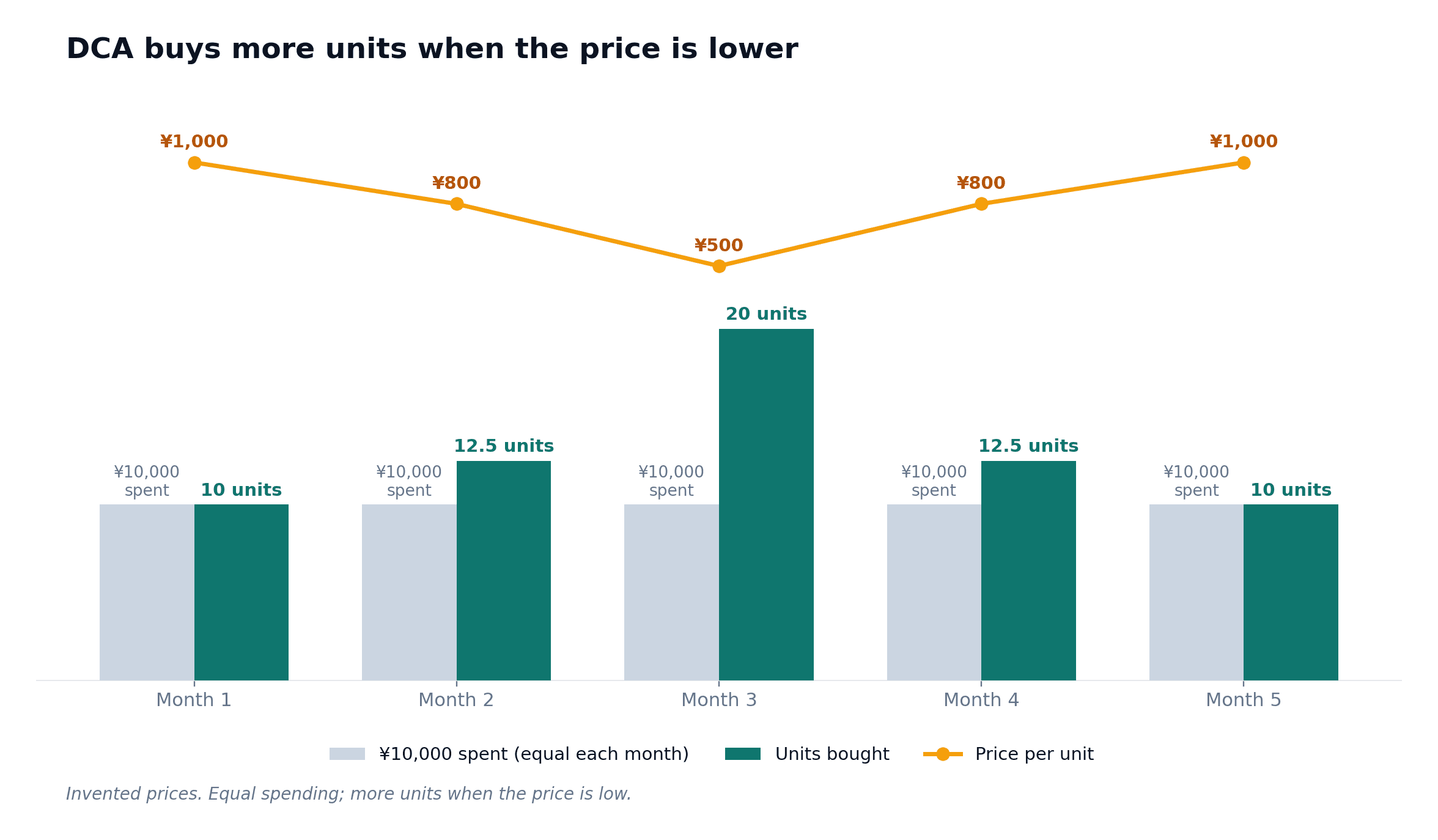
Read diagram as text
Months 1–5 prices per unit are JPY 1,000; 800; 500; 800; 1,000.
At JPY 10,000 each month, quantities are 10; 12.5; 20; 12.5; 10 units.
Fees are omitted. Total spending is JPY 50,000 for 65 units, giving about JPY 769.23 per unit. This illustrates quantity changes, not a recommended schedule.
Section 2 of 4
Rebalancing and written exit rules
Rebalance back to your plan
A gardener in Canberra trims her hedge back to its chosen shape each spring; otherwise the fastest branches take over. Rebalancing is the trim.
In the sizing and exposure lessons in Level 8, Fernanda's token drifted from half to three-quarters of her holdings. The same drift happens between crypto and the rest of your savings.
Rebalancing sells some of what has risen, which can feel wrong in a rising market. It is not a prediction that prices will fall, only a way to keep your risk where you decided. The next question is when to do it.
Choose calendar or threshold rebalancing
A car in Johannesburg can be serviced every 12 months or whenever a warning light comes on. Investor.gov describes the same two approaches for portfolios.
| Comparison point | Calendar | Threshold |
|---|---|---|
| Rule | Rebalance on set dates, for example every six or twelve months | Rebalance when a holding drifts more than a set amount from its target |
| Example | "Every 1 January and 1 July" | "When crypto goes above 7.5% or below 2.5% of my savings" (invented) |
| Strength | Simple to remember; fewer decisions | Responds to big moves; may act less often in calm periods |
| Weakness | Can leave large drift in place for months | In crypto's 24/7 market a threshold can be crossed at any hour, tempting constant checking |
Investor.gov notes that rebalancing tends to work best when done relatively infrequently. Each sale can carry fees and may have tax consequences where you live, so a rule that triggers every week can cost more than it saves. Many people combine the two: check on set dates, and act only if the drift is beyond a threshold.
Rebalancing keeps the mix in shape. It does not decide when you leave altogether, which deserves its own plan.
Write your exit plan before you need it
Imagine a hiking group on Mount Fuji that agrees a turnaround time before setting off: if they haven't reached the summit by then, they go down, however close it feels. The decision is made at the bottom, with a calm head, not near the top when excitement and tiredness are high.
An exit plan does the same for an investment, and it has four parts. A goal exit says what you are investing for and what you will do if you reach it. Partial profit-taking sells set fractions at prices written in advance, so you never have to pick the perfect top. A thesis invalidation names the facts that would show your reason for buying was wrong, whatever the price. Finally, a time and life exit sets a review date and says what you will sell if you suddenly need the money.
Order tools help, with limits. Kraken's support pages explain that a take-profit order triggers when the last traded price touches your level and then executes as a market order, so in a fast or thin market it can fill noticeably below your trigger. It is also an independent order that you may have to cancel yourself if you exit another way. Swapping into a stablecoin is not the same as cashing out to your bank, as Level 3 showed, and Level 9 looks at the feelings that tempt people to tear up exit plans.
Every buy, sale, rebalance and exit creates a record, and keeping them is the next habit.
The process may require sales, purchases or directing new contributions, each with costs and possible tax consequences. A rule should identify the target, review time and action, rather than say rebalance when needed. A sell signal does not guarantee that the desired amount can be moved into a bank account immediately. Emergency spending needs should not depend on an untested assumption about instant liquidation.
Section 3 of 4
Complete records, local requirements and the policy
Keep a complete transaction and transfer ledger
Record date, time zone, asset, quantity, network, venue, price, fee asset, currency value, transaction ID and purpose. Preserve statements and source documents. A transfer between your own wallets can change location without creating a trading profit; fees and local tax rules may still matter. Rewards, disposals and conversions need their own entries.
Realised and unrealised describe different result stages under an accounting convention. A valuation change in an unsold holding is not a cash receipt. A deposit increases account value but is not market performance. A withdrawal reduces account value without necessarily being a trading loss. Reconcile external cash flows before using drawdown or return tools. Clear records prevent a larger balance caused by new deposits from being mistaken for successful investing.
Keep a record of every transaction
A fabric trader in Istanbul's Grand Bazaar keeps a receipt book. At the end of the year, the book, not memory, shows what was bought, for how much, and what was sold. Crypto needs the same book, and nobody will keep it for you.
HMRC, the UK tax authority, warns that exchanges may keep transaction records only for a short time, or may no longer exist when you need them, so the responsibility falls on the individual. Level 3 showed how quickly an exchange can disappear.
| Field | Why it matters |
|---|---|
| Date and time | Values and rules depend on when it happened |
| Type | Buy, sell, swap, transfer, reward, gift or fee |
| Asset and number of units | Tracks what you hold |
| Value in your home currency | Gains and losses are usually measured in it |
| Fees paid, and in what asset | Fees can affect cost basis; a fee paid in crypto may itself be a transaction |
| Platform or wallet, with addresses | Shows where the asset moved from and to |
| Transaction ID or exchange reference | Lets you prove the record later |
| Running total held | Catches errors early |
The UK, US and Australian tax authorities list similar items, and the Australian Taxation Office (ATO) says to keep records for at least five years after you dispose of crypto. One kind of record causes more confusion than any other: moving coins between your own wallets.
Record transfers between your own wallets
Moving cash from your jacket to your wallet in Manchester isn't spending it, and moving crypto from an exchange to your own hardware wallet is similar: you still own it. But on a blockchain it looks like coins leaving one address for another, and without a record it can be mistaken for a sale.
Official guidance in different countries shows why the detail matters. The IRS says that moving digital assets between wallets or accounts you own does not by itself count as a digital asset transaction for the yes-or-no question on its tax return, unless you paid a transaction fee with digital assets. The ATO says a transfer between your own wallets is not a disposal as long as you keep ownership, but if your holding is reduced to pay a network fee, that fee is a disposal with capital gains consequences. These are dated examples of how two authorities treat it, not rules for you.
Knowing what to record is half the task; knowing whose rules apply is the other half.
Find local record requirements and write the policy
Tax treatment varies by jurisdiction, asset and activity. Sales, exchanges, rewards, transfers and losses may be treated differently. The IRS digital-asset guidance is a US example of why transaction records matter; it is not a global tax rule. A learner in Canada, India or Germany must check the relevant current official authority and obtain suitable advice for personal circumstances.
Use a complete fictional ledger in the course and label the accounting assumptions. Do not upload real account numbers or secrets. Finish with a review date and triggers for revising the plan, such as changed redemption rights or loss of an off-ramp. The next level focuses on habits and testing so that a well-written policy is evaluated through consistent paper practice rather than emotion.
Find your own tax authority's guidance
Tax rules for crypto differ by country, change often and depend on personal circumstances. This course gives no tax advice, but it can show you where to look.
Start with your national tax authority's website and search for "crypto" or "digital assets". Examples include HMRC's Cryptoassets Manual in the UK, the IRS digital assets pages in the US and the ATO's crypto pages in Australia; Canada, India, South Africa and others have their own. Check the date on each page, because guidance is updated. The IRS, for example, notes that brokers must report digital asset sales on a new form, 1099-DA, for transactions from 1 January 2025.
If your situation includes staking rewards, airdrops, DeFi, business activity or more than one country, consider a qualified tax professional. Good records make their job, and yours, far easier. You now have every piece for one written document.
Draft your portfolio risk policy
A household in Washington, D.C., that writes down its budget and who pays which bill argues less when money gets tight. A written portfolio-risk policy makes decisions in calm moments so you don't have to make them in loud ones.
| Section | What to write |
|---|---|
| Purpose and time horizon | Why I hold crypto, and for how long |
| Money that stays out | Emergency fund status; essential money never used |
| Total loss budget | ______ in my home currency, reviewed on ______ |
| Per-idea risk | Most I will lose on one idea: ______ |
| Concentration limits | Largest share in one asset ___, one provider ___, one stablecoin ___, one smart contract ___ |
| Leverage and borrowing | My rule (for example "none while learning") |
| How money goes in | Lump sum or DCA; frequency; fee limit |
| Rebalancing | Calendar, threshold or both; my target mix and bands |
| Exit plan | Goal, partial profit-taking, thesis invalidation, time and life exits |
| Records | Where I keep them; what I record; who knows where they are |
| Review and pause | Review date; what makes me stop and reassess |
This template is the first draft of the portfolio-risk policy in your graduation project in Level 10. Level 9 will fold it into a wider personal crypto plan and show you how to review it honestly.
Section 4 of 4
Everyday example, practice and review
Try the following questions aloud or on paper before opening the worked answers. Compare your reasoning as well as your final answer.
Try it yourself
Try each question on paper or explain your answer aloud before opening the worked answers. This practice is for learning; it is not scored.
1. Calculate total quantity with GBP 2 deducted from each purchase budget.
2. Why is a transfer between owned wallets not automatically a trading gain?
3. Write three details needed in a cash-out plan.
Compare with the worked answers
Worked answers
1. 198 ÷ 20 + 198 ÷ 25 + 198 ÷ 10 = 9.9 + 7.92 + 19.8 = 37.62 units.
2. It moves an existing holding rather than creating a price profit. Fees and local reporting treatment still need review.
3. Executable market and size, supported withdrawal and bank route, fees and conversion, processing time and outage contingency are relevant.
Quick knowledge check
Try each question on paper or explain your answer aloud before opening the worked answers. This practice is for learning; it is not scored.
Does DCA prevent an asset from losing most or all of its value?
Compare with the worked answers
Worked answers
No. It spreads entry under a schedule; the underlying asset and access risks remain.
What to remember
✓ Average cost equals total relevant cost divided by acquired units.
✓ An exit plan includes the cash-out route.
✓ Separate cash flows, transfers and performance in records.
Lesson completion check
References and further reading
References
Kraken: How to deposit cryptocurrencies to your Kraken account ↗
Investor.gov: Investor.gov — Dollar Cost Averaging ↗
Vanguard: Vanguard — Lump-sum investing versus cost averaging: Which is better? ↗
End of Level 8
You've finished the lessons in this level. Review what you learned before continuing.