Liquidity Provision and Impermanent Loss
Section 1 of 3
Provide liquidity and compare with holding
Your learning goal
Compare liquidity-provider proceeds with the result of simply holding the same initial assets.
Providing liquidity is not the same as holding two assets unchanged. A pool changes the provider's asset mix as relative prices move. The term impermanent loss describes a comparison with a hold-only benchmark under specified assumptions. It does not always mean a cash loss, and it does not promise that the difference will disappear.
Key idea
Name the benchmark whenever you describe a liquidity-provider result.
Education only. Crypto assets can lose substantial value or become worthless. No lesson requires buying an asset, depositing money or sharing real passwords, private keys or recovery words.
What a liquidity provider contributes
Think of a community library in Melbourne where neighbours donate books and share the small late-return fees. The more they put in, the larger their share.
A liquidity provider (LP) deposits both tokens of a pair in equal value, for example 1 ETH and 2,000 USDC at an invented price of 2,000. The contract issues LP tokens as a receipt for their share. Uniswap's documentation describes these as pro-rata shares that can be redeemed for the reserves at any time. Fees are added to the pool, so when the LP redeems, their share includes fees collected.
Here the library analogy breaks down. A donated book stays the same book, but every swap changes a pool's balance, so what you withdraw can differ greatly from what you put in. That change has a name.
A liquidity provider deposits assets into a pool under its rules and receives an accounting interest or position representing a share of the pool. A withdrawal generally returns the asset mix the position then represents, not necessarily the original quantities. Fees, ranges and position structure depend on the version. Do not compare a displayed yield with a savings account without examining how the principal can change.
Follow a relative price change
Use a full-range, two-asset constant-product pool, ignoring fees and costs. Initially it holds ten practice coins priced at USD 100 and 1,000 stable quote units assumed worth USD 1. Its value is USD 2,000 and product k is 10,000. If the coin's outside price rises to USD 200 and arbitrage brings the pool ratio into line, x becomes approximately 7.0711 and y approximately 1,414.2136.
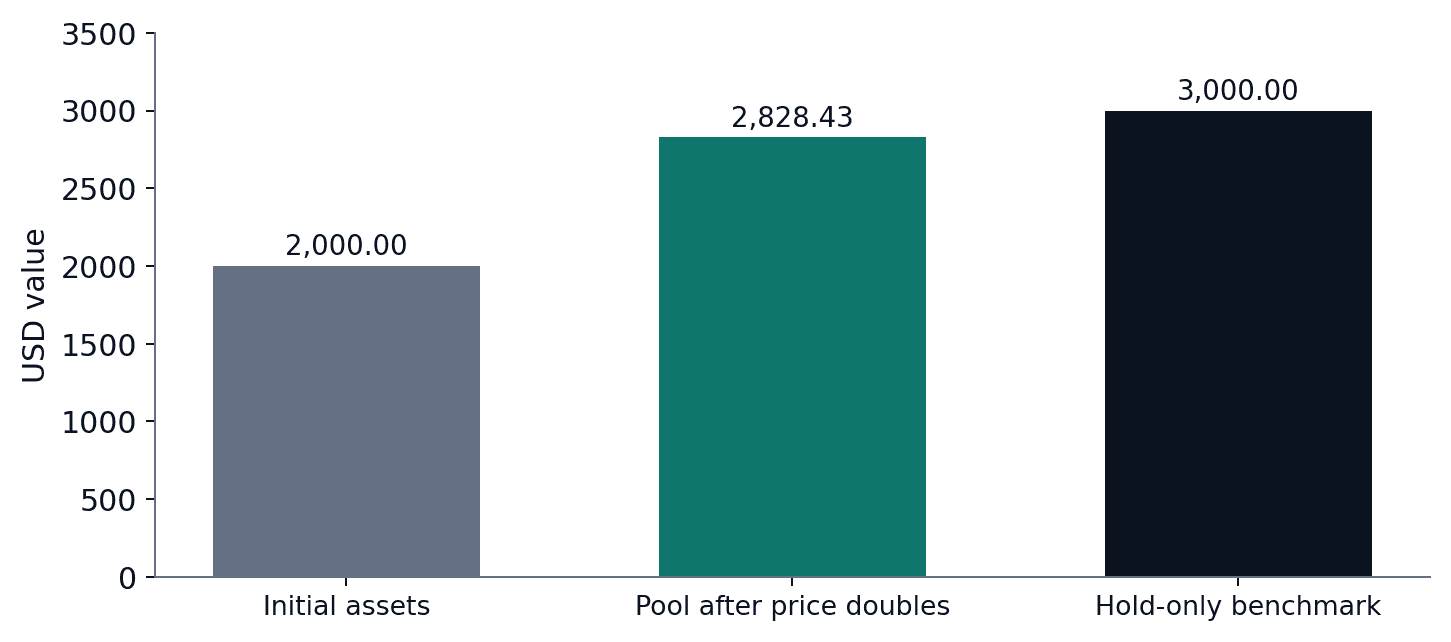
The pool has fewer rising coins and more quote units. At the new price, each side is worth about USD 1,414.21, giving total value USD 2,828.43. The assumptions include a stable quote value and adjustment to the outside price. Real pools may differ because of fees, ranges, other flows and market conditions. This example isolates the rebalancing effect rather than forecasting a live position.
Compare with holding the original assets
If the original ten coins and 1,000 quote units had simply been held, their value at USD 200 per coin would be USD 3,000. The pool value is approximately USD 171.57 lower. Relative to the hold-only benchmark, that is about 5.72 percent less. This is the illustrated impermanent loss before fees and costs.
Notice that the pool still gained USD 828.43 compared with the initial USD 2,000. A position can rise in cash value while underperforming the hold-only alternative. Always state the benchmark and denominator. Comparing only with the starting cash would answer a different question and could hide the opportunity cost. If the quote asset also changes value, the benchmark and pool calculation must both reflect that change.
| Measure | Starting position | After coin price doubles |
|---|---|---|
| Coin price | USD 100 | USD 200 |
| Hold-only coins | 10 | 10 |
| Hold-only quote | 1,000 | 1,000 |
| Hold-only value | USD 2,000 | USD 3,000 |
| Pool coins | 10 | About 7.0711 |
| Pool quote | 1,000 | About 1,414.2136 |
| Pool value | USD 2,000 | About USD 2,828.43 |
| Pool minus hold | Record your notes and evidence here | About negative USD 171.57 |
Full-range constant-product illustration. Stable quote, no fees, no incentives and no costs are assumed.
Imagine two friends in Rome keeping a joint box split 50/50 by value between euros and a fast-moving stock. Each time the stock rises, the rule forces them to sell some, so they end up holding less of it than if they had left it alone.
Read diagram as text
Initial assets: USD 2,000. After the illustrated price doubles, pool value: approximately USD 2,828.43. Holding the original assets: USD 3,000.
The pool gains against initial cash but trails the hold-only benchmark by about USD 171.57, or 5.72%.
The comparison assumes no fees or costs.
Section 2 of 3
Fees, rewards and concentrated liquidity
Fees, incentives and impermanent loss
Trading fees can offset some or all of the benchmark difference, but the result is not guaranteed. Incentive tokens may change price or be difficult to sell. Subtract entry and exit costs, network fees and other relevant charges. Compare the full net position with the same initial assets held under a fair benchmark.
The term impermanent refers to the fact that the relative difference can change as prices change before withdrawal. It is not a promise that prices will return, that losses will recover or that the provider should wait indefinitely. Asset collapse, a stablecoin depeg or a contract exploit introduces risks beyond the isolated model. A complete result distinguishes modelled rebalancing from those additional failures.
The percentage shortfall is tied to a particular benchmark and pool model. For a full-range equal-value two-asset constant-product position without fees, the relative factor can be written as 2√r ÷ (1+r), where r is the new relative price divided by the starting relative price. Subtract one for the signed difference, or subtract the factor from one for a positive shortfall percentage. At r=2, the shortfall is about 5.72% of holding.
Do not describe that as a 5.72% loss of the initial cash. In the supplied doubling example, the pool gains against initial cash and still trails simply holding the starting assets. If both assets fall in the home currency, a position can also lose against initial cash. Relative underperformance and absolute loss are separate measurements.
Concentrated liquidity needs its own analysis
In a standard pool, your liquidity is spread across every price from near zero to near infinity, and most sits where trades never happen. Uniswap's documentation gives the example of a dollar-stablecoin pair trading between US$0.99 and US$1.01, where only about 0.5% of an older-style pool's money was used.
Uniswap's version 3 introduced concentrated liquidity: an LP chooses a price range, and their money only works inside it, earning more fees per dollar there. Outside the range, the position stops earning, and as the price moves through the range it gradually turns into only one of the two tokens.
Think of a street vendor in Seoul who sets up only where the crowd is, and earns nothing once it moves on. Narrow ranges need watching and adjusting, each adjustment costs gas, and losses from price moves are sharper. Higher fees here come with more work and more risk.
Whatever the pool design, your swap waits in public before it enters a block. Some people make a business of that wait.
Within the range, the position can be more sensitive to price changes and earn fees under the version's rules. Outside the active range, it may hold predominantly or entirely one asset and stop earning trading fees until conditions or the position change. Do not apply the simple full-range percentage to every concentrated position. A displayed high APR may reflect a narrow range or a recent short period rather than a stable result. The next lesson examines lending collateral, which has a different loss mechanism: liquidation.
Section 3 of 3
Everyday example, practice and review
Try the following questions aloud or on paper before opening the worked answers. Compare your reasoning as well as your final answer.
Try it yourself
Try each question on paper or explain your answer aloud before opening the worked answers. This practice is for learning; it is not scored.
1. Calculate the pool's gain against the initial USD 2,000.
2. Calculate the shortfall as a percentage of the USD 3,000 benchmark.
3. If net fees add USD 100, does that fully offset the illustrated shortfall?
Compare with the worked answers
Worked answers
1. USD 2,828.43 minus USD 2,000 equals about USD 828.43.
2. USD 171.57 divided by USD 3,000 is about 5.72 percent.
3. No. It reduces the shortfall to about USD 71.57 before any additional costs or reward-value changes.
Quick knowledge check
Try each question on paper or explain your answer aloud before opening the worked answers. This practice is for learning; it is not scored.
Can impermanent loss coexist with a positive cash-value gain?
Compare with the worked answers
Worked answers
Yes. It measures performance relative to holding the starting assets, not automatically a loss from the initial cash amount.
What to remember
✓ Liquidity provision changes the asset mix.
✓ The benchmark must hold the same starting assets.
✓ Fees and incentives require a separate net calculation.
Lesson completion check
References and further reading
References
Uniswap: What is Impermanent Loss ↗
Chainlink: Understanding Impermanent Loss in DeFi ↗
Uniswap docs: Uniswap docs — How Uniswap works (v2 protocol overview) ↗