Lending, Borrowing, Collateral and Liquidation
Section 1 of 4
Lending, collateral and borrowing limits
Your learning goal
Explain a collateralised loan and calculate a simplified health factor.
A lending protocol can let a user supply assets, use eligible collateral and borrow another asset. The available borrowing limit is not a recommendation. Debt, interest and collateral prices can move against the borrower, and the protocol may liquidate under its rules. We will follow the balance sheet and calculate a simplified health factor.
Key idea
Stress both sides of the balance sheet, including interest and oracle assumptions.
Education only. Crypto assets can lose substantial value or become worthless. No lesson requires buying an asset, depositing money or sharing real passwords, private keys or recovery words.
Supplying collateral and borrowing
Ask where the interest on a crypto deposit comes from
When a bank in Frankfurt pays you interest on savings, the money has a source. The bank lends your deposit to borrowers, charges them more than it pays you and keeps the difference. In many countries a deposit guarantee also protects you if the bank fails.
DeFi apps also advertise returns on deposits, often called yield. Some are modest, some are startling. Every one of them is paid by someone, and the first job of this lesson is to find out who. The second is to see what can go wrong, because crypto yields carry no deposit guarantee.
You met one source in the swap and liquidity lessons in Level 6: trading fees paid to liquidity providers. The biggest other source is lending, so start with how a DeFi lending pool works.
See how a lending pool works
Think of a family savings box in Jakarta. Several relatives put money in, and any relative who needs a loan borrows from the box and pays interest back into it. Nobody lends to one particular person; everyone shares the box.
A DeFi lending pool works the same way, but the box is a smart contract and the relatives are strangers. Aave, which began as ETHLend in 2017, founded by Stani Kulechov, describes itself as a non-custodial protocol where users take part as suppliers or borrowers. Compound is another long-running example. Suppliers deposit a token, such as a stablecoin, into the pool and receive a token representing their deposit (Aave calls these aTokens), which grows as interest accrues. Borrowers take tokens out and pay interest in.
The interest rate is not set by a manager. Aave's documentation explains that rates follow utilisation: the share of the pool's money currently borrowed. When most of the pool is lent out, rates rise to attract more suppliers and discourage borrowing. When little is borrowed, rates fall. Supplier interest therefore changes from day to day.
The savings-box analogy breaks down on trust. Relatives know each other and can chase a missed payment. A DeFi pool knows nothing about its borrowers, cannot take them to court and has no credit check. So how does it stop borrowers walking away with the money?
Borrow against collateral over collateralisation
A pawnshop in Rio de Janeiro answers the same problem. It does not know you, so it holds your gold watch worth R$1,000 and lends you perhaps R$600. If you do not repay, the shop sells the watch.
DeFi lending uses the same idea, called over-collateralisation. You deposit collateral worth more than you borrow. Aave's documentation states that borrowers must pledge assets worth more than their loan, protecting the protocol from defaults. Each collateral asset has a loan-to-value (LTV) ratio: the most you can borrow against it. With a 75% LTV, US$20,000 of collateral lets you borrow up to US$15,000 (invented figures for this example).
Why borrow at all if you must lock up more than you get? People borrow stablecoins to spend without selling their crypto, or to borrow more crypto and bet on a price rise, which is leverage. The BIS has pointed out a system-wide risk here: when collateral prices fall, forced sales of collateral can push prices down further, triggering more sales. DeFi lending can amplify a crash rather than absorb it.
A pawnshop asset can also change value. Crypto collateral can change sharply and continuously, so the pool needs a way to watch every loan continuously. That is the health factor.
Supplying an asset makes it available under the protocol's pool rules and may earn variable interest. Not every supplied asset is eligible collateral, and choosing collateral status can change risk. Withdrawals depend on available pool liquidity and the account's collateral obligations. A displayed supplied balance does not necessarily mean every unit can be withdrawn immediately. Receipt or accounting tokens also depend on the protocol. A lending interface should be read as a set of connected assets and obligations rather than a high-yield deposit screen.
LTV and liquidation threshold are different
Loan-to-value, or LTV, concerns permitted borrowing relative to collateral under defined rules. A liquidation threshold is the level used to assess liquidation eligibility. They serve different purposes and can differ by asset and configuration. Some systems combine multiple assets through weighted rules, with additional restrictions or modes.
Borrowing at a permitted maximum leaves little room for price changes, interest or rule adjustments. The protocol allowing an action does not make it prudent. Read the current configuration and distinguish maximum eligibility from your own affordable risk boundary. Liquidation can involve a bonus or penalty and the sale or transfer of collateral. The exact mechanics and portion liquidated depend on the protocol and state, so do not impose one universal percentage.
Section 2 of 4
Health factor and liquidation boundaries
For the supplied example, health factor equals eligible collateral value multiplied by its liquidation threshold, divided by debt value. With USD 1,000 collateral, an 80 percent threshold and USD 500 debt, the health factor is 1.6. If collateral falls to USD 600 while debt remains USD 500, it becomes 0.96.
Under the stated example's rule, a result below one indicates liquidation eligibility. At exactly USD 625 collateral, the calculation gives one, which is the boundary rather than a comfortable buffer. Real protocols can use multiple assets, weighted thresholds, accrued interest and special rules. The example isolates the ratio; it is not a live borrowing instruction or a guarantee of the precise liquidation outcome.
| Collateral value | Threshold | Debt value | Health factor |
|---|---|---|---|
| USD 1,000 | 80 percent | USD 500 | 1.60 |
| USD 800 | 80 percent | USD 500 | 1.28 |
| USD 625 | 80 percent | USD 500 | 1.00 |
| USD 600 | 80 percent | USD 500 | 0.96 |
| USD 700 | 80 percent | USD 560 | 1.00 |
Single eligible collateral, one debt and unchanged threshold are assumed. Boundary and liquidation rules remain protocol specific.
Imagine a fuel gauge for your loan. Full means plenty of room; empty means trouble. In Aave, the gauge is a single number called the health factor.
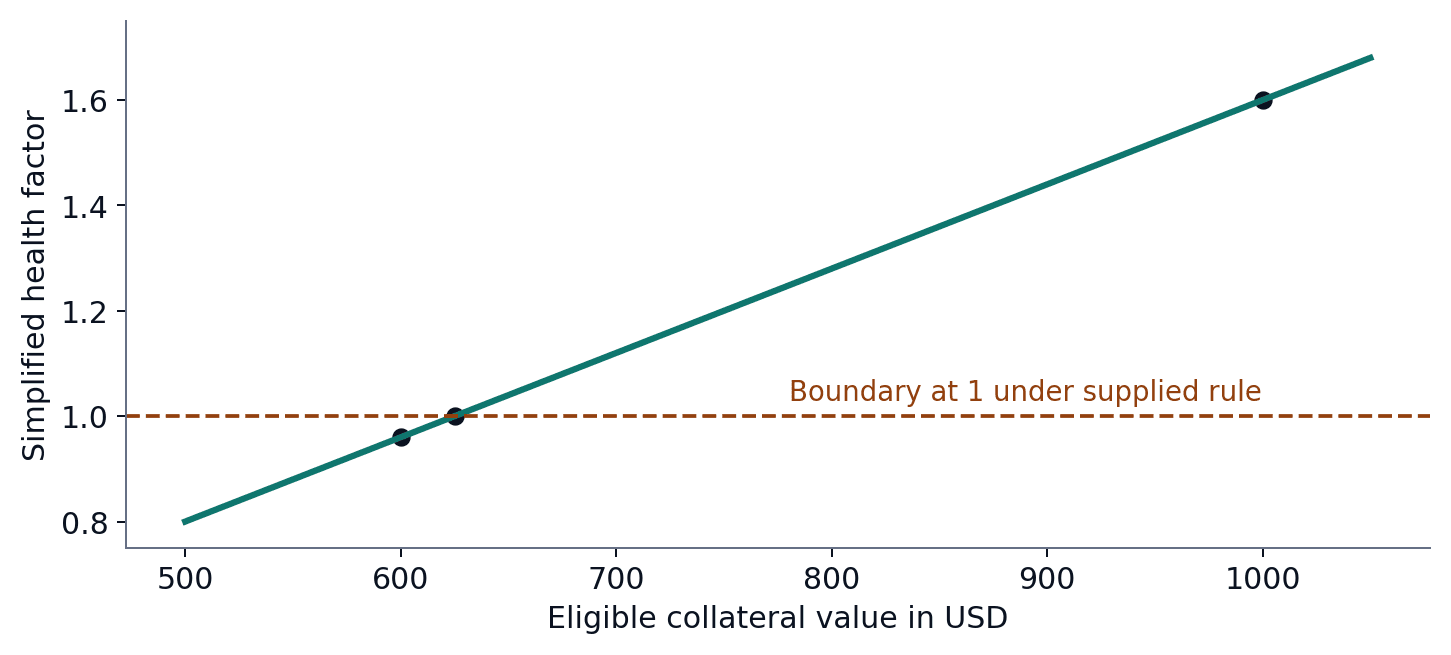
Read diagram as text
Horizontal axis: eligible collateral value in USD. Vertical axis: simplified health factor = collateral × 0.80 ÷ USD 500 debt.
Examples: USD 600 gives 0.96; USD 625 gives 1; USD 1,000 gives 1.6.
The dashed boundary is 1 under the supplied rule. Real weighted inputs and liquidation rules can differ.
Section 3 of 4
Stress scenarios, liquidation and exit limits
Stress debt, collateral, interest and data
Collateral price can fall, debt price can rise and interest can accumulate. A stablecoin used as debt or collateral can depeg. An oracle can update late or deliver a manipulated value, affecting the protocol's assessment. Configuration changes can also alter thresholds. Several changes may occur together during stress.
For example, with USD 700 collateral and USD 560 debt, an 80 percent threshold produces health factor one. Even without a collateral fall, debt interest can push the ratio lower. An external chart showing a different spot price does not necessarily determine the protocol's liquidation reference. Record which oracle and valuation rules the system uses. A safe-looking ratio based on the wrong inputs is not useful protection.
Liquidation and the limits of an exit
Liquidation eligibility allows specified actors or mechanisms to act under the protocol rules. An attempted repayment or collateral addition may arrive too late, face congestion or fail. A stop order on another venue cannot force an on-chain lending protocol to wait. Holding extra tokens in a wallet does not help unless they are usable through a timely appropriate action.
This course requires a paper worksheet and dependency explanation rather than a loan. Record collateral, debt, units, rate assumptions, threshold, oracle and stress cases. Explain what fails first and which exit action would be needed. The result should include uncertainty about fees and execution. The next lesson compares lending yield with native staking and other reward arrangements so that distinct risks are not hidden under one earn label.
Section 4 of 4
Everyday example, practice and review
Try the following questions aloud or on paper before opening the worked answers. Compare your reasoning as well as your final answer.
Try it yourself
Try each question on paper or explain your answer aloud before opening the worked answers. This practice is for learning; it is not scored.
1. Calculate health factor at USD 900 collateral and USD 600 debt with the same threshold.
2. At USD 500 debt, what collateral value produces a factor of one?
3. Name two changes besides a collateral fall that can reduce the factor.
Compare with the worked answers
Worked answers
1. 900 × 0.8 ÷ 600 = 1.2.
2. 500 ÷ 0.8 = USD 625. This is a boundary, not a recommended buffer.
3. Debt interest, a rise in debt-asset price, a lower liquidation threshold or an adverse oracle update can reduce it.
Quick knowledge check
Try each question on paper or explain your answer aloud before opening the worked answers. This practice is for learning; it is not scored.
Is the maximum permitted borrowing amount a prudent borrowing recommendation?
Compare with the worked answers
Worked answers
No. It is a protocol eligibility limit. Affordability, price movement and execution risk need separate judgment.
What to remember
✓ Debt units and collateral value must both be tracked.
✓ LTV and liquidation threshold have different roles.
✓ Health factor is useful only with correct current inputs.
Lesson completion check
References and further reading
References
Stani Kulechov interview on Ethereum: Building ETHLend and naming Aave ↗
Aave Labs: Aave Labs Contributions Report ↗
Aave: Health Factor and Liquidations ↗
Chainlink: What is a Blockchain Oracle ↗