Staking, Yield and the Source of Rewards
Section 1 of 4
Reward sources, staking and provider risks
Your learning goal
Identify where a quoted return comes from and which risks accompany it.
A reward rate is incomplete until you can explain where the reward comes from and what happens to the principal. Native staking, lending, liquidity incentives and centralised earn accounts are different activities. This lesson separates them, explains APR and APY, and shows why a high displayed rate is not a complete measure of return.
Key idea
Every yield figure needs a source, a denominator, a period and a risk explanation.
Education only. Crypto assets can lose substantial value or become worthless. No lesson requires buying an asset, depositing money or sharing real passwords, private keys or recovery words.
Name the activity that earns a reward
Trace where yield comes from
Think of a market trader in Shanghai asking where her profit came from: customers paying for goods, a supplier's discount, or a one-off promotional voucher. Only the first is likely to last.
DeFi yield has a similar set of sources. Kraken's learning guide names three main ones: lending interest paid by borrowers, trading fees paid by swappers to liquidity providers, and token rewards, often newly created tokens a protocol hands out to attract deposits. Staking rewards, covered below, are a fourth.
| Source | Who pays | What it depends on | Main risk |
|---|---|---|---|
| Lending interest | Borrowers | Demand to borrow | Bad debt, liquidation failures, code bugs |
| Trading fees | Traders swapping in a pool | Trading volume | Impermanent loss, low volume |
| Token rewards (emissions) | New tokens created by the protocol, ultimately buyers of those tokens | The token's market price | Token price falling as rewards are sold |
| Staking rewards | The blockchain's protocol and transaction fees | The network's rules and activity | Slashing, lock-ups, intermediaries |
Token rewards deserve a closer look, because they produce the largest numbers.
Ask who is paying when yield looks too good
A shop in Toronto offering a free C$50 voucher with every purchase can run that promotion for a while. It cannot run it forever unless the vouchers are funded by something real.
Token emissions are the crypto version. A protocol creates new units of its own token and gives them to depositors. In the supply and allocation lessons in Level 5 you saw that new supply dilutes holders. Kraken notes that a very high yield can reflect how risky the underlying assets are, and rewards paid in new tokens last only while the protocol keeps creating them and buyers still want them.
The deeper rule is this: if you cannot see where the yield comes from, you may be the yield. In a Ponzi scheme, new deposits pay earlier depositors. Centralised "earn" products can hide their sources too. In the exchange failure lesson in Level 3 you saw how Celsius, a lending platform that paid high yields, paused withdrawals in June 2022 and filed for bankruptcy in July 2022. DeFi at least lets you inspect the contracts, but inspection only helps if you check.
Once you know the source, you can compare offers fairly, and that means reading the percentage correctly.
Native consensus staking commits an asset to a network's validation process under its rules. A BTC earn account, for example, is not Bitcoin native proof-of-stake participation. It may involve lending, custody or another arrangement. Compare products by source, control, loss mechanism and exit conditions rather than by one advertised percentage.
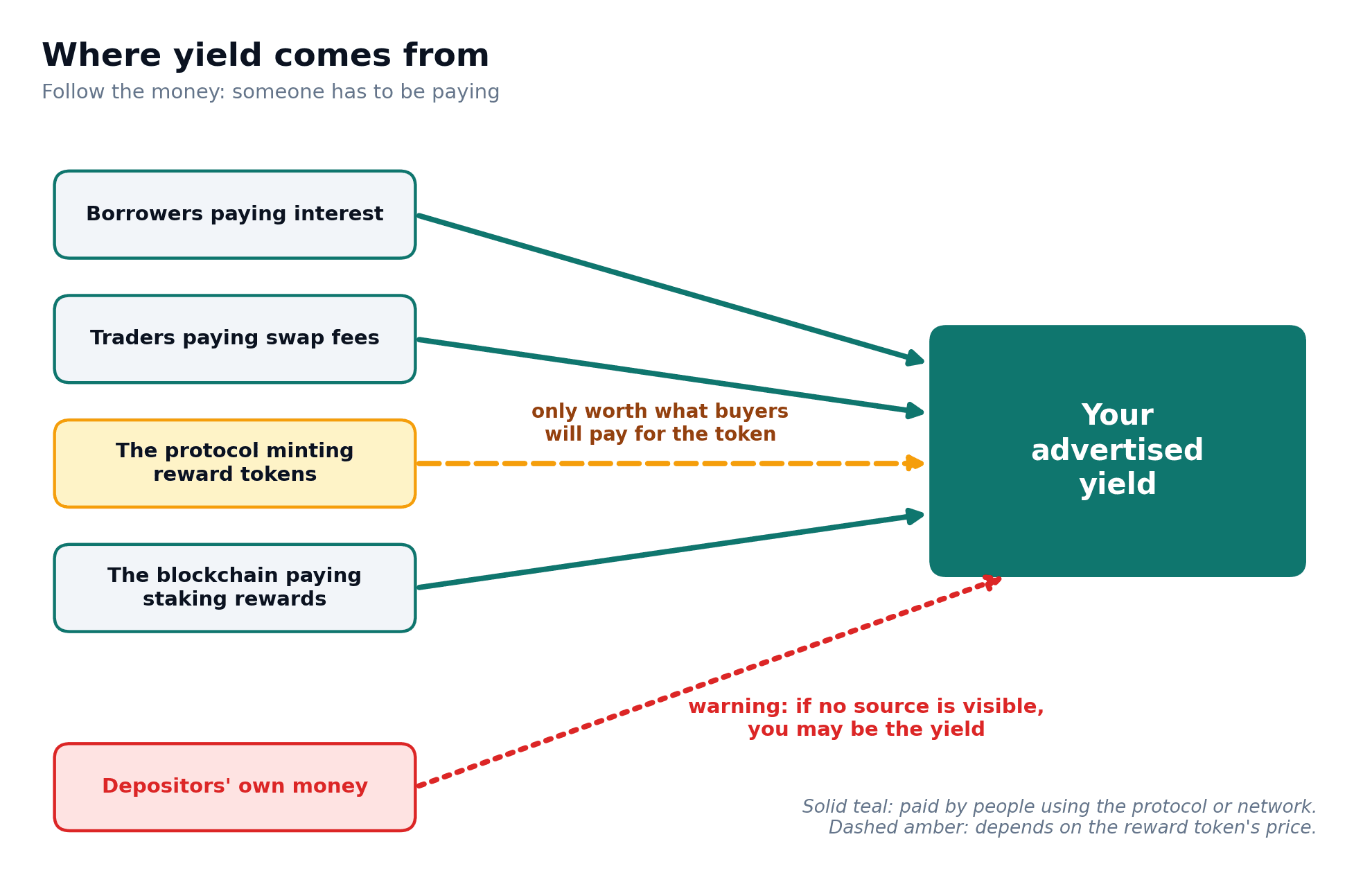
Read diagram as text
Borrower interest, trader swap fees and blockchain staking rewards are shown as possible sources.
Minted reward tokens have a separate dashed path because their value depends on buyers and transfer conditions.
Depositors’ own money is a warning path. Identify who pays each reward; an advertised percentage does not establish its sustainability.
Native staking and added provider dependencies
Validators may earn rewards while facing inactivity penalties, slashing for specified violations and operational requirements. Exit timing depends on network rules and demand. A pool or provider can introduce fees, contract risks, operator concentration and custody arrangements. A displayed staked quantity can have different withdrawal conditions from an ordinary liquid balance.
Check how rewards are calculated and who controls withdrawal credentials or equivalent authority. A product that simplifies operation may change the user's rights and dependencies. A service fee can reduce rewards, and loss of the underlying asset's national-currency value can exceed reward income. Earning more units does not guarantee earning more purchasing power. The principal and reward asset must both be included in the result.
In the Ethereum and contract lessons in Level 4 you learned that Ethereum's validators lock up ETH as a deposit to secure the network. ethereum.org describes staking as two things at once: the security mechanism of proof of stake and a way to earn rewards for honest work. Running your own validator needs 32 ETH, hardware and technical skill, but you keep full control.
Rewards come with penalties. Validators that go offline lose small amounts. Slashing is harsher: for clearly dishonest behaviour, such as signing two conflicting blocks, part of the stake is destroyed and the validator is removed.
Staked ETH is not instantly available either. Withdrawals are enabled, but exiting a validator means waiting in a queue that grows when many people leave at once. ethereum.org compares four routes, each trading control for convenience.
| Route | Minimum | Who runs the validator | Extra risk you take on |
|---|---|---|---|
| Solo home staking | 32 ETH | You | Your own technical mistakes |
| Staking as a service | 32 ETH | An operator; you keep withdrawal control | Operator errors |
| Pooled or liquid staking | Small amounts | Many operators via a smart contract | Smart-contract and token risks |
| Centralised exchange | Any amount | The exchange | Custody; the exchange holds your ETH |
For most people the pooled route is the practical one, and it introduces a new kind of token.
Section 2 of 4
APR, APY and the value of rewards
APR, APY and compounding assumptions
A savings account in Paris might quote one rate per year but add interest monthly. Interest added in January earns interest in February, so you end the year with slightly more than the quoted rate.
DeFi apps show two kinds of figure. APR (annual percentage rate) is simple yearly interest, ignoring compounding. APY (annual percentage yield) includes the effect of reinvesting returns, as Kraken's guide explains. The same pool can look better quoted as APY.
APY = (1 + APR ÷ n)^n − 1Compare these annualised figures with the native staking rewards discussed in Step 2. Both the reward source and the compounding assumptions matter.
APR is commonly presented as an annualised rate without the effect of compounding under stated assumptions. Starting with 1,000 units produces about 1,104.71 units under that artificial fixed-rate model. Actual rates may vary, rewards may require manual reinvestment and fees may reduce the result. If rewards are paid in a different token, its price changes and conversion costs matter. The compounding worksheet in the calculation reference demonstrates the arithmetic; it does not forecast a protocol's rate or the asset's future price.
Revenue, emissions and the passive-income claim
Rewards can come from user fees, borrower interest, new token issuance or treasury subsidies. New emissions can increase the holder's units while diluting other holders or adding potential selling supply. A rate funded by temporary incentives may end when the budget is exhausted. Fee revenue can vary with activity and may not all accrue to the relevant position.
Ask whether the quoted rate is gross or net, historical or forward-looking, and measured in token units or national currency. The phrase real yield should still be traced to its source and beneficiary. A project can earn revenue while a particular token has no entitlement to it. A credible explanation names the payer, mechanism, costs and risks rather than relying on the attractiveness of the number.
Adverts often promise passive income: money that arrives while you sleep. The phrase is misleading in DeFi for three reasons.
First, the returns are not fixed. Rates move with borrowing demand, trading volume and token prices, and they can fall to almost nothing. Second, the risks are active. Liquidations, depegs, slashing and contract bugs can strike overnight, so a position needs regular checking, which is work. Third, the phrase hides the question of who pays. A return that really is passive and also high is a classic sign of a scheme paying old depositors with new money.
A fairer description is "a variable return for taking specific risks". When you see a yield, write down its source, the risks in each layer and what you would do if the rate dropped or the token lost its peg.
Now test yourself on the numbers and the questions.
Section 3 of 4
Receipt tokens, liquid staking and restaking
Liquid-staking arrangements can issue a receipt or representation associated with staked assets. The token may trade away from the underlying redemption value because of liquidity, fees, exit delays or confidence. Using it in another protocol adds that protocol's collateral, oracle and liquidation risks. A liquid label does not make every exit immediate at par.
Restaking can expose stake or its representation to additional validation or security services under extra rules. That can introduce additional penalty, operator and contract dependencies. We examine the wider security path at Level 10. At this stage, draw the chain from underlying stake to provider to receipt token to any further application. More layers can generate more advertised rewards while also creating more ways the principal or access can fail.
Use liquid staking tokens and know their risks
Think of a coat-check ticket in Milan. Your coat stays in the cloakroom, but you hold a ticket you could hand to someone else.
Liquid staking works like that. Lido, a well-known example, takes ETH from many users, stakes it through professional node operators and issues a token, stETH, representing each user's share. Lido's documentation says the token stays freely transferable, so holders can use it in other DeFi apps while earning rewards, and that Lido takes a 10% fee on staking rewards, split between node operators and the treasury of Lido's governing community (the DeFi dependency lesson in Level 6 explains how such communities govern).
Lido's own public risk disclosure lists the risks: smart-contract bugs, slashing that in severe cases can exceed rewards, governance changes, node-operator failures, withdrawal queues, and the token trading below the value of the ETH behind it during market stress. Concentration matters too: if one service controls a large share of all staked ETH, a failure there affects the whole network.
Liquid staking stacks one layer of risk on another. Restaking adds a third.
Look briefly at restaking and its extra risks
ethereum.org describes restaking as using ETH that is already staked to secure additional services, in return for extra rewards. EigenLayer pioneered the idea in 2023. Restakers commit their stake to outside services, and those services can slash it if their rules are broken. Liquid restaking tokens then represent those positions, the same way stETH represents a staked position.
Picture lending your house keys to a neighbour, who also lends them to a building manager, who also uses them for a second building. Each step pays you a little more, and each adds someone whose mistake could cost you. ethereum.org lists the risks: extra slashing, chain reactions where a failure in one service spreads to others, centralisation among a few operators, and longer withdrawal delays. For a beginner, it is enough to recognise restaking as yield built on top of yield, with risks stacked the same way.
These added dependencies reinforce the caution about passive income in Step 4: more reward streams can also mean more ways to lose value or access.
Section 4 of 4
Everyday example, practice and review
Try the following questions aloud or on paper before opening the worked answers. Compare your reasoning as well as your final answer.
Try it yourself
Try each question on paper or explain your answer aloud before opening the worked answers. This practice is for learning; it is not scored.
1. Calculate approximate ending units on 1,000 at fixed 10 percent APR with monthly compounding.
2. What happens to value with 10 percent more units and a 30 percent price fall?
3. Name three facts missing from a claim of 20 percent yield.
Compare with the worked answers
Worked answers
1. Approximately 1,104.71 units before fees under the stated constant-rate assumptions.
2. Value becomes 77 percent of the starting amount, a 23 percent decline before costs.
3. Reward source, principal risk, reward asset, fees, compounding basis, variability and exit terms are relevant missing facts.
Quick knowledge check
Try each question on paper or explain your answer aloud before opening the worked answers. This practice is for learning; it is not scored.
Is a high APY a guarantee of a positive national-currency return?
Compare with the worked answers
Worked answers
No. Rates, asset prices, fees, access and principal risks can change the result.
What to remember
✓ Name the economic activity behind the reward.
✓ APR and APY require stated assumptions.
✓ Count principal value and exit terms as well as reward units.
Lesson completion check
References and further reading
References
SEC Investor.gov: Crypto Asset Custody Basics for Retail Investors ↗
Chainlink: Understanding Real Yield in DeFi ↗
Aave: Aave — Aave documentation overview ↗