Emotions, Biases and Attention in Crypto Markets
Section 1 of 5
FOMO, FUD and the hype cycle
Your learning goal
Recognise a decision trigger and choose a deliberate response.
A well-written plan can be abandoned in a few seconds when a price moves or a social post creates urgency. The purpose of this lesson is not to eliminate emotion. It is to make emotion visible without letting it silently change the evidence, budget or rules. These habits improve the quality of practice; they do not guarantee profit.
Key idea
Use a rule written before urgency changes your attention.
Education only. Crypto assets can lose substantial value or become worthless. No lesson requires buying an asset, depositing money or sharing real passwords, private keys or recovery words.
Why does a crypto course need a level about you
Think about shopping for a phone in a big online sale. A countdown ticks, a banner says "only 3 left" and friends post their new phones. Nothing about the phone has changed, yet you feel you must decide now. The pressure comes from the setting, not the product.
Levels 0 to 8 taught you how crypto works and fails. This level is about the person pressing the buttons. Investor psychology studies how feelings, attention and habits shape decisions under uncertainty. It has no single founder; you will meet some of the research in the bias and psychology lesson in Level 9.
One idea runs through the whole level: a feeling is real, but it is not a price signal. You do not need to feel nothing. You need to notice the feeling, name it and check it against rules you wrote while calm.
The sale analogy stops working in one place. A sale ends at midnight; crypto pressure never closes, so this lesson ends with practical brakes. This course is educational, not mental-health treatment, and watching without buying is a complete way to learn.
The best-known feeling in crypto even has its own acronym, so start there.
Recognise FOMO when it arrives
Imagine a new bakery opening in Seoul with a queue round the corner. You had not planned to buy bread, but the queue makes you wonder what you are missing, and soon you have joined it.
In crypto, FOMO usually arrives with three companions: speed, other people's gains and no new information. A coin jumps 40%, screenshots fill your group chat and your urge says "buy now". Your plan asks other questions. Has anything changed apart from the price? Would it pass the token checklist from the token research lesson in Level 5? Does it fit your limits from Level 8? Urgency cannot answer any of them.
The analogy breaks down because a real queue usually says something true about the bread. In crypto the crowd can be manufactured: the token research lesson in Level 5 showed how paid promotion, bots and wash trading create the look of demand.
FOMO pushes you to buy. Its twin pushes you to sell, or to stop listening.
Recognise FUD and do not use the label to silence real warnings
Picture a rumour in an Istanbul market that one stall's scales are rigged. Shoppers walk away without checking, and by evening the stall is empty, whether or not the rumour was true.
FUD can be deliberate: a frightening post can push nervous holders to sell cheaply to the person who wrote it. Panic-selling at 3 a.m. after an anonymous rumour is the classic mistake. Communities also use the word as a shield. When someone raises a fair concern, fans reply "that's FUD" and move on. That reply is not evidence. The exchange failure lesson in Level 3 showed that withdrawal pauses, unexplained yields and secrecy appeared before several exchange failures. A warning does not become false because a community dislikes it.
| What you see | Likely pull | What to check |
|---|---|---|
| "Up 50% today, don't miss it" | FOMO | Has anything changed except price? Does it pass my checklist? |
| "This coin goes to zero tonight" from an anonymous account | FUD | Who posted it? Is there a primary source? |
| Your regulator's warning list names the platform | Evidence | Read the regulator's page yourself |
| An influencer says "last chance" with a sign-up link | FOMO and possible paid promotion | Is payment disclosed? Who benefits if you click? |
FOMO and FUD rarely appear alone. They rise and fall with a bigger wave.
Use the hype cycle as a map of feelings
Think of a new restaurant in Melbourne: queues and glowing reviews in the first month, then slow nights and a thinning crowd, then, if the food is good, a steady base of regulars.
The research firm Gartner describes a similar pattern for new technologies, called the hype cycle. Its five phases are an "Innovation Trigger" (early stories and media interest), a "Peak of Inflated Expectations" (some successes, many failures), a "Trough of Disillusionment" (interest falls, weaker providers leave), a "Slope of Enlightenment" (real uses become clearer) and a "Plateau of Productivity" (mainstream use).
Crypto narratives often feel like this. A new idea appears, such as the 2017 ICO boom from Level 5, and "this time is different" spreads. Then disappointments pile up and only some projects remain in use.
Here the analogy stops. Gartner's model describes expectations about a technology, not prices; it gives no timing, and many crypto narratives never reach a plateau. So use the curve to ask "which phase do my feelings belong to?", never "when should I buy?"
What pushes a narrative up that steep slope? Usually attention, and one kind of token runs almost entirely on it.
Fear of missing out, or FOMO, is the urge to act because others appear to be gaining an opportunity you may lose. Research on decision-making under risk, including Kahneman and Tversky's 1979 prospect theory, helped explain why reference points and framing matter. These ideas describe patterns rather than diagnose every individual or guarantee a particular behaviour. A feeling is information about your state, not a new contract right or improved liquidity.
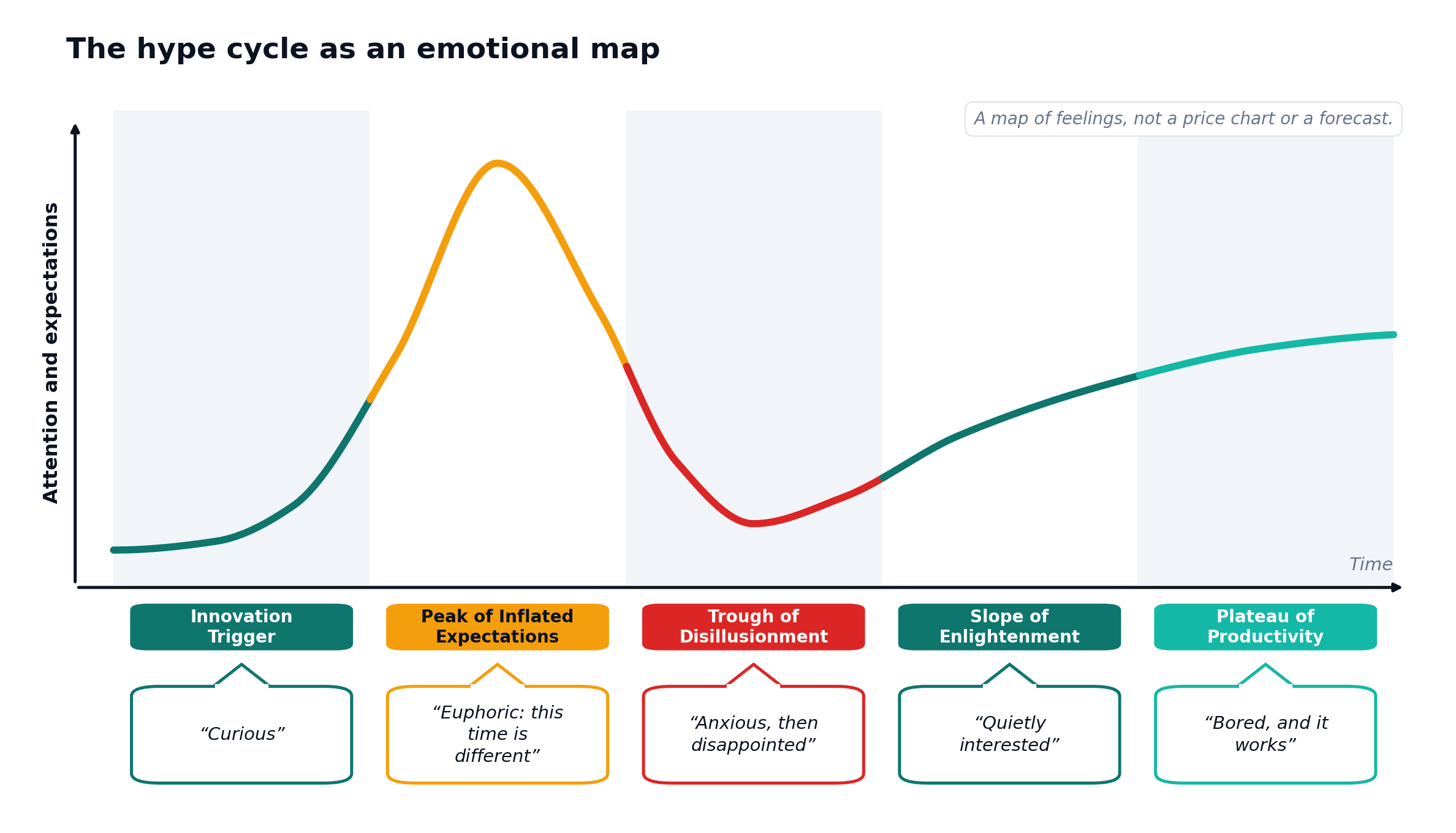
Read diagram as text
Stages: innovation trigger (“curious”); peak of inflated expectations (“this time is different”); trough of disillusionment (“anxious, then disappointed”); slope of enlightenment (“quietly interested”); plateau of productivity (“bored, and it works”).
The vertical axis is attention and expectations; the horizontal axis is conceptual time. This is an emotional map, not a price path or timetable.
Section 2 of 5
Promotion, memes and signal groups
See how meme coin mania spreads
You met memecoins in the token purpose lesson in Level 5 and their warning signs in the token research lesson in Level 5. Here the focus is how the excitement spreads.
Think of a dance craze in Mexico City: everywhere for two weeks, then gone when a new one arrives.
Meme-coin mania runs a similar loop. The price rises, people post about it, the posts bring new buyers, and their buying lifts the price again. Each turn feels like proof, but the loop needs a steady supply of new buyers. When they stop arriving it runs backwards. Unlike the dance craze, the people who joined last can lose real money.
Curiosity is not foolish. Some people buy a little of a memecoin for fun, like a lottery ticket. If you do, call it entertainment spending with a fixed limit you could lose completely, not an investment, and notice if entertainment money starts becoming savings money.
The attention behind a mania has to come from somewhere, and often someone was paid to create it.
Question influencers and paid promotion
When a famous footballer advertises running shoes, you assume they were paid. Crypto promotion is harder to spot, because it often looks like a friendly tip from someone you feel you know.
The token research lesson in Level 5 covered the 2022 case against Kim Kardashian. On 22 March 2023 the US SEC charged eight more celebrities, including Lindsay Lohan, Jake Paul and Akon, for promoting crypto-asset securities without disclosing they were paid. Six settled, without admitting or denying the findings, paying more than US$400,000 in total. The SEC also warns that fraudsters pay actors to pose as ordinary people turned millionaires.
In the United Kingdom, FCA guidance published on 26 March 2024 says that unauthorised people, such as social-media influencers, who promote a regulated financial product without approval from an FCA-authorised firm may be committing a criminal offence. Rules differ by country, so check your own regulator's guidance.
Influencers speak to strangers. Group chats feel like friends, which can make them more persuasive.
Handle group chats and signal groups with care
Picture neighbours in Johannesburg sharing a business "tip" in a group chat. Nobody wants to be the one who says "this sounds wrong". Crypto's version is the signal group, where an organiser posts "calls" to buy a coin, sometimes for a monthly fee. The US CFTC warns that pump-and-dump organisers gather people through messaging apps and message boards, some with thousands of members, and build excitement with countdowns such as "15 mins left before the pump". It notes that the people pulling the strings get out first and make the most, leaving everyone else scrambling to sell.
Even honest groups share incomplete information: people post wins, not losses or fees.
Monthly cost drag (%) = monthly cost ÷ account value × 100Feeds, chats and prices share one thing: they never sleep.
Section 3 of 5
Recognise biases and challenge your own story
Loss aversion, anchoring and confirmation bias
Treat a bias as a pattern to check not a verdict
Every driver has a blind spot, however skilled. Good drivers do not pretend it is not there; they check their mirrors before changing lanes.
The earlier steps examined pressure from outside. We now look inside, at the shortcuts our minds take. The labels are tools for asking better questions, not insults or diagnoses.
Keep the observation separate from the explanation. "I only read posts that agreed with me" is something you can check. "Confirmation bias may have affected me" is one possible explanation. The fix starts with the checkable action: go back and read the posts you skipped.
The analogy stops working in one way. A mirror removes most of a blind spot, but knowing a bias's name does not make you immune to it. You still need written rules and records, so each section below ends with a countermeasure.
So where did these labels come from?
Know where the research comes from and its limits
In 1979 the psychologists Daniel Kahneman and Amos Tversky published "Prospect Theory: An Analysis of Decision under Risk". It showed that people judge outcomes as gains or losses from a reference point, such as the price they paid, rather than by their total wealth. In 2002 Kahneman received the Nobel Memorial Prize in Economic Sciences for bringing insights from psychology into economics, especially about judgement under uncertainty. Tversky had died in 1996. Their work helped start behavioural finance, though investor psychology has no single founder.
Regulators and educators have since studied crypto buyers directly. The UK FCA's 2024 consumer research estimated that 12% of UK adults, around 7 million people, owned crypto. About one in five said friends and family were the main reason they bought. A 2023 study by the FINRA Investor Education Foundation and CFA Institute found that half of US Gen Z investors reported making an investment driven by fear of missing out, and 44% had started their investing with crypto.
These findings describe groups, not you, and none of them predicts a price. Use them to know which questions to ask, then check your own records.
The first question concerns the reference point Kahneman and Tversky described.
Feel loss aversion and the disposition effect
Imagine finding ₹500 on a street in Kolkata, then losing ₹500 a week later. On paper you are even, yet most people remember the loss more sharply.
Some studies estimate that losses weigh roughly twice as much as equal gains. Researchers still debate the figure, and it varies by person and situation, so treat it as a tendency rather than a fixed rule.
Loss aversion helps explain the disposition effect, which the SEC's Investor.gov describes as holding losing investments too long and selling winners too soon. Selling a winner feels like locking in a pleasant gain. Selling a loser turns a paper loss into a real one, which hurts, so people wait for it to "come back".
Your countermeasure: write exit rules before you buy, as the recurring purchase and records lesson in Level 8 showed, and use the fresh-money question at every review.
A purchase price is one reference point. An old peak can be an even stronger one.
Notice anchoring to an all time high
A family in Melbourne turns down an offer of A$900,000 for their house because a neighbour's sold for A$1,000,000 two years ago (invented amounts). The old number feels like the "real" value, even though the market has changed.
In crypto the strongest anchor is often the all-time high. Bitcoin rose above US$68,000 in November 2021, and by November 2022 it was trading below US$18,000. It fell roughly 75% from its November 2021 high to its November 2022 low. Holders anchored to the peak said "I'll sell when it gets back there", as if the market owed them that price.
Gain needed to recover = L ÷ (1 − L), where L is the loss as a decimal.Your countermeasure: judge a holding by today's price and your written thesis, not by its peak. Your old high belongs in your records as a drawdown measure, not as a target.
Anchors fix you to a number. The next bias fixes you to a story.
Catch confirmation bias and echo chambers
A football fan in Buenos Aires remembers every bad call against their team and none in its favour. Their attention filters what sticks.
Crypto makes this hard to avoid. Feeds learn what you like and show you more of it, and communities around a coin share mostly good news. Before long your timeline becomes an echo chamber, where you hear your own view repeated back.
Your countermeasure: before any decision, write the best case against it and name one fact that would prove you wrong. Apply the same checklist to coins you like and coins you dislike.
When the story is about a whole community, belief can turn into belonging.
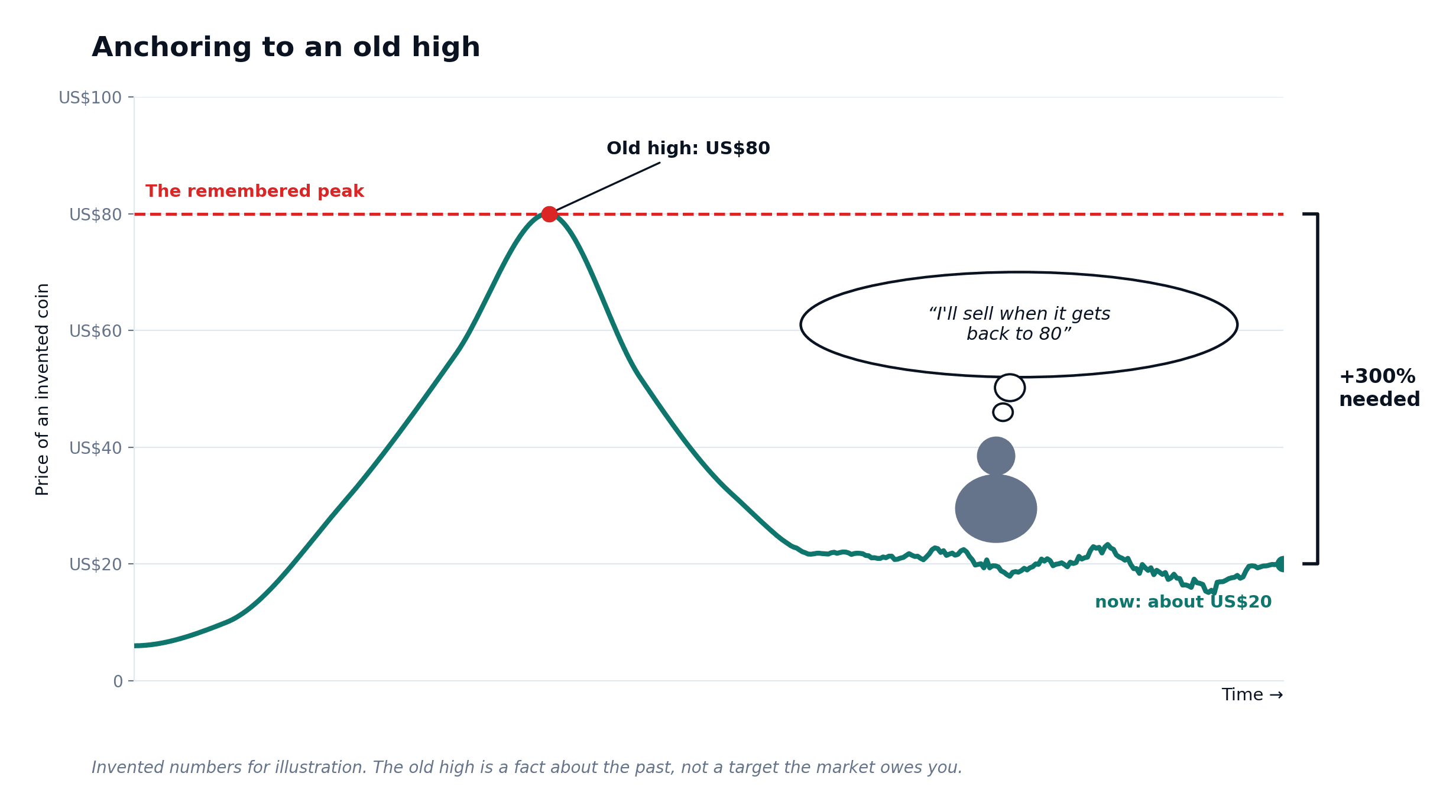
Read diagram as text
The remembered old high is USD 80. Current illustrated price is about USD 20.
Returning from 20 to 80 requires (80 ÷ 20 − 1) × 100 = 300% growth.
The thought bubble says the holder will sell when price gets back to 80. The old high is a past observation, not a price owed by the market.
Sunk costs, tribalism, recency and overconfidence
Watch identity and tribalism
Fans do not switch football clubs after a lost match. That loyalty is lovely in sport; in money it can be expensive.
Strong views are not wrong. Trouble starts when a coin becomes part of your identity: criticism feels personal, people who disagree become "enemies" and selling feels like betrayal. Tribalism often lies behind the "that's FUD" habit examined in Step 1.
Your countermeasure: keep your holdings private and off your profile, and practise describing the strongest case for a coin you do not own.
Loyalty looks backwards over years. The next bias overweights the last few weeks.
Keep recency in proportion
After three sunny weeks in Cape Town, it is tempting to pack away your umbrella for good. Recent experience feels like the whole story.
Recency bias gives the latest events too much weight compared with the full record. After a month of rises, crypto can feel like a one-way street; after a quiet year, its old swings can feel like history. Neither short run tells you what comes next.
Your countermeasure: when you review, look at the longest history you can find, including the worst falls, not only the last few weeks.
Recent wins do something else, too. They make people feel clever.
Check overconfidence after a bull run
When the tide rises in Southampton harbour, every boat goes up, well-built or leaky. A rising market makes every buyer feel skilled.
Overconfidence means treating your knowledge or skill as greater than the evidence supports. A learner who recognises a few chart patterns may feel ready to explain a product without checking its custody, rights or costs. A written evidence checklist makes the missing work visible.
Overconfidence leads to bigger positions, more trades and skipped checks. A winning breach of your rules is still a breach.
Your countermeasure: compare your results with a simple benchmark, keep your position limits from Level 8 whatever your recent results, and record losses as carefully as wins.
Overconfidence comes from recent wins. The next bias comes from past costs.
Let go of sunk costs
You paid €60 for a concert in Berlin, but on the night you feel unwell and it is pouring. Many people go anyway "because we paid". The €60 is gone either way.
Crypto offers plenty of sunk costs: fees paid, hours of research, months spent in a community, coins locked in a project you no longer trust.
Sunk cost differs from loss aversion: it is about past effort or spending you feel must not be "wasted", not the pain of a loss on the holding.
Your countermeasure: ask "What would I do if I were starting fresh today?" and let past costs stay in your records, not in your decision.
Sometimes the pull to keep going does not come from your past. It comes from everyone around you.
Notice herding and survivorship bias
In a Jakarta food market, a stall with a long queue attracts more people because of the queue. That is a fair shortcut for lunch, a weaker one for money.
Herding is following what others are doing because they are doing it. Investor.gov describes manias and panics: rapid rises driven by crowds buying, followed by sharp falls when the crowd sells. The surveys above hint at herding: some buyers cite friends, family or fear of missing out.
Herding feeds on stories, and stories are filtered. Survivorship bias means drawing conclusions only from the cases that survived. You hear about the coin that rose a thousandfold and the friend who bought early. You rarely hear about the tokens that disappeared or the people who lost money, because they have nothing to post.
Your countermeasure: for every success story, ask "How many tried this, and what happened to them?" If you cannot find out, treat the story as an advert.
Herding and survivorship push you in. The last group of biases appears after you are already in and things go wrong.
Avoid a bounce is due revenge trading and overtrading
Toss a fair coin in a Toronto classroom. After five tails, the next toss is still 50% heads; the coin owes you nothing.
The gambler's fallacy is believing that a run of outcomes makes the opposite "due": "five red days, a bounce must be coming". The analogy has a limit. Crypto prices are not coin tosses and nobody knows their probabilities, so a losing streak neither makes a win more likely nor proves the next day is 50:50.
Revenge trading is trading to win back a loss quickly, often with a bigger size or riskier product. Overtrading is trading more often than your plan supports, sometimes from boredom. Both add costs and risk without adding evidence.
Total trading fees = number of trades × average trade size × fee rateYour countermeasure: set a maximum number of trades per week, a pause after any loss you did not plan for, and a cooling-off rule, which we will develop in Step 5.
You have now met each bias on its own. In real decisions they arrive together, so a single table helps.
Match each bias to a countermeasure
A pilot in Paris does not rely on memory; the checks are written down. Your countermeasures work best the same way, as a list you consult before acting and at review.
| Bias | How it shows up | Countermeasure |
|---|---|---|
| Loss aversion and disposition effect | Selling winners early, holding losers "until they come back" | Exit rules written before buying; fresh-money question |
| Anchoring | Waiting for an old all-time high | Judge by today's price and thesis; record the peak as drawdown only |
| Confirmation bias | Reading only bullish posts | Write the best case against; name what would prove you wrong |
| Tribalism | Calling every critic an enemy | Keep holdings off your profile; explain the other side fairly |
| Recency bias | "It doesn't drop like it used to" | Review the longest history, including the worst falls |
| Overconfidence | Bigger positions after a bull run | Compare with a benchmark; keep Level 8 limits |
| Sunk cost | "I've put too much in to stop" | Ask what you would do starting fresh today |
| Herding and survivorship | Buying because others got rich | Ask how many tried and failed |
| Gambler's fallacy, revenge trading, overtrading | "A bounce is due", doubling up, constant trades | Trade limits, a pause after losses, cooling-off rule |
In the planning and review lessons in Level 9 you will write these countermeasures into a personal crypto plan and a decision journal. First, practise.
A sunk cost is a past commitment that cannot be recovered by choosing differently now. The fact that you spent hours researching or bought at a higher price does not oblige future buyers to restore that price. The arithmetic of recovery does not make a larger gamble appropriate. A 50 percent drawdown requires a 100 percent gain to recover before costs, but that fact does not improve the probability of the next idea.
Section 4 of 5
Protect attention and journal your reasoning
Protect attention and use circuit breakers
Live with a market that never closes
Crypto trades 24 hours a day, 7 days a week, every day of the year. Level 0 showed that there is no closing bell to give you a pause.
Think of a supermarket open all night. It works because staff work in shifts, but you have no night shift to hand over to. Watch a market that never closes and something gives way: sleep, work or family time. Tired people can make faster, rougher decisions, the opposite of what a volatile market needs.
Compulsive price-checking means opening the app again and again for no reason linked to your plan, and each red or green number can stir a fresh urge to act.
Daily checking time = number of checks × average minutes per checkThe analogy stops there: a night shift serves real customers, while night-time checking mostly serves the feeling of control. Planned checking windows, built later in this lesson, give you the information without the pull. Some of that pull, though, is designed.
Notice when an app or product starts to feel like a game
Games keep you playing with frequent rewards. In a financial app, the same tricks can encourage more and faster decisions than your plan allows.
In November 2022 the UK FCA published research on trading apps, some offering crypto. It found falling confetti and congratulations after trades, points, badges, leaderboards ranking users by activity, flashing price alerts and high default amounts. In its survey, about 1 in 27 users (3.75%) showed "problem gambling behaviour", similar to the 1 in 29 (3.5%) it cited for online gamblers. On two apps with these features that also offered crypto, almost half of surveyed customers had invested in products potentially beyond their risk appetite.
Some products add speed of their own. Leverage (the leverage lesson in Level 8) can turn a small move into a large loss within hours, memecoins can halve in a day, and very short-term trades give a result almost at once, like a spin of a wheel. The rush, the near miss and the urge to go again can feel much like gambling.
Enjoying excitement is human; the question is whether the activity stays inside limits you chose calmly. Warning signs include chasing losses, hiding activity from people close to you, borrowing to keep going, losing sleep and feeling restless when you cannot check.
If design can push you to act faster, design can also slow you down.
Build circuit breakers starting with friction regulators use
A speed bump outside a school in Rome does not stop anyone driving; it slows them where speed is most dangerous. Regulators use the same idea, often called positive friction: a small delay where impulsive decisions cause harm.
The UK offers a dated example. From 8 October 2023, FCA rules for crypto promotions require firms to give first-time customers a personalised risk warning and a cooling-off period of at least 24 hours before showing them a direct offer to invest, and to check they understand the risks. "Refer a friend" bonuses were banned, and promotions must warn: "Don't invest unless you're prepared to lose all the money you invest." Other countries use other tools, so check your own regulator.
The speed bump has a limit: the FCA's wait applies when you are new to a firm. After that, only you can slow yourself down. Some stock exchanges pause trading after a very sharp fall, a pause called a circuit breaker. You can write a personal version.
A cooling-off rule is the simplest one: "I wait 24 hours before buying anything I first heard about today, and I write one sentence on why I want it." The number is your choice, not a universal safe interval. Waiting does not make a failed checklist pass; it gives your calm self a turn to speak.
Your second set of breakers is alert hygiene. Keep security alerts on, because a login or withdrawal you did not make needs your attention at once. Turn down the rest.
| Alert or habit | Noisy setting | Calmer setting |
|---|---|---|
| Price alerts | Every 1% move on many coins | None, or only levels written in your plan |
| App notifications | All on, including promotions | Security alerts on (logins, withdrawals, new devices); marketing off |
| Social feeds | Following every account that posts gains | Mute or unfollow accounts that hide paid promotion |
| Group chats | Notifications on all day | Muted and read at a set time, or leave |
| Night-time | App beside the bed | App off the home screen; do-not-disturb overnight |
| Checking | Whenever bored or anxious | Two fixed checking windows a day, or fewer |
Breakers work best when practised before the pressure arrives, so try them now.
Crypto markets can operate around the clock, while people cannot maintain reliable attention indefinitely. Use conditions for doing nothing: incomplete evidence, insufficient sleep for careful checking, an unexplained permission or an unresolved route. Time boundaries do not ensure a better market outcome; they reduce impulsive interruptions and make the process easier to review. You do not need to monitor every price to complete this course.
After a loss, schedule a review before changing the rule rather than immediately increasing exposure. It cannot ensure profit or eliminate all mistakes, but it makes exceptions visible. Discipline is then assessed as adherence and reasoning, rather than inferred from a favourable balance.
Journal feelings separately from evidence
A useful journal records the time, research question, available evidence, emotional state, intended action and actual action. Add whether the original rule was followed and what result occurred. Do not write only I felt confident or the trade worked. The separation helps identify cases where a correct process lost money or an unsupported action happened to gain.
Use fictional accounts and omit personal secrets. Review patterns such as acting after a social message, changing an exit after entry or skipping fee checks when tired. A journal is valuable when it changes a specific habit or reveals a repeated mistake, not when it becomes a long account of every price movement. Pick one observable improvement for the next practice period.
Section 5 of 5
Everyday example, practice and review
Try the following questions aloud or on paper before opening the worked answers. Compare your reasoning as well as your final answer.
Try it yourself
Try each question on paper or explain your answer aloud before opening the worked answers. This practice is for learning; it is not scored.
1. Write a pause rule for an urgent promotional message.
2. A profitable action broke the risk policy. Was its process automatically good?
3. List four fields for a decision journal.
Compare with the worked answers
Worked answers
1. Stop before sending or signing, identify the request, verify independently and require the original evidence and budget checks.
2. No. Outcome and adherence are separate. A rule-breaking gain can reinforce a dangerous habit.
3. Time, evidence, feeling, intended action, actual action, rule adherence and result are suitable fields.
Quick knowledge check
Try each question on paper or explain your answer aloud before opening the worked answers. This practice is for learning; it is not scored.
Does being disciplined guarantee profitable results?
Compare with the worked answers
Worked answers
No. Discipline can improve consistency and checking, while market and operational outcomes remain uncertain.
What to remember
✓ Emotion should be recorded without becoming evidence.
✓ Past cost does not establish future value.
✓ Assess adherence separately from outcome.
Lesson completion check
References and further reading
References
Daniel Kahneman and Amos Tversky: Prospect Theory An Analysis of Decision under Risk ↗
CFTC: Beware Virtual Currency Pump and Dump Schemes ↗
Investor.gov (SEC): Investor.gov (SEC) — Behavioral Patterns of U.S. Investors (2014) ↗
UK FCA: UK FCA — Research Note: Cryptoassets consumer research 2024 ↗