Choose the Loss Budget Before the Position Size
Section 1 of 4
Essential money and your loss budget
Your learning goal
Calculate a planned spot quantity and explain why the result is only an estimate.
Position sizing begins with a loss boundary, not with the number of units you would like to own. Even then, a planned loss is an estimate that depends on execution. We will calculate a simple fully paid spot example, include a cost allowance and check the units. The exercise does not prescribe a suitable real-world allocation or risk percentage.
Key idea
Size from an explicit loss allowance and then stress the assumptions.
Education only. Crypto assets can lose substantial value or become worthless. No lesson requires buying an asset, depositing money or sharing real passwords, private keys or recovery words.
Start with the money that must stay out
Think of a family in Recife, Brazil, who keep their money in labelled envelopes. One says "rent", one says "food", one says "school". When a friend suggests a promising side business, they don't open the rent envelope to fund it, however small the share sounds. The first decision about risk is which money is never at risk at all.
You met this idea in Level 0. An emergency fund is cash kept for surprise bills in a safe, accessible place such as a bank account, and it comes first. Money for rent, food, healthcare, school fees and loan repayments stays outside crypto too. The US Commodity Futures Trading Commission (CFTC) advises speculating only with money you can afford to lose, and the UK Financial Conduct Authority (FCA) says crypto investors should be prepared to lose all their money.
The envelope picture stops working in one way: envelopes hold a fixed amount, while crypto changes value every minute. So the next step is to turn "spare money" into a firm number.
Set a personal loss budget
A shop owner in Melbourne trying a new product line decides in advance how much unsold stock she could write off. She doesn't wait to see how sales feel, and that written number protects her from deciding under pressure.
A loss budget works on two levels: the whole crypto pot, and a smaller slice for each separate idea or position.
Hannah's numbers are about loss, not about how much she buys. Confusing the two is a common sizing mistake, so the next section turns a loss number into a size.
A fictional learning balance is not an instruction to use an equivalent real sum. A loss budget should not be increased merely because the latest idea feels compelling. Two learners with the same savings can have different obligations and appropriate choices. This course therefore does not supply a universal percentage of capital to risk. A mathematically correct quantity can still be unsuitable if the underlying funds cannot be lost.
Section 2 of 4
Define the idea and calculate the size
Decide the loss before the size
A shopper in Kolkata has ₹300 for mangoes. At ₹30 each, that buys ten; at ₹60, five. The budget stays fixed and the quantity changes. Position sizing works the same way, except you divide by the distance to your planned exit.
For a trade, first decide the price at which your idea is wrong. Measure how far that is from your entry, as a fraction of the entry price, and divide your loss budget by that fraction. CME Group's trading course describes the same two steps: place the exit at a logical level first, then size the position so the money at risk matches what you accept.
Position size = amount at risk ÷ distance to exit (as a fraction), where distance to exit = (entry price − exit price) ÷ entry price for a purchase.Two adjustments keep this honest. First, costs: if James expects about £5 in fees and a worse fill, he sizes from £45, giving £450. Second, rounding: exchanges sell in fixed steps, so always round units down. If even the smallest allowed order would lose more than £50 at the exit, the answer is zero, and skipping the trade is a valid result.
This formula assumes you have a planned exit. Many people who hold crypto for years don't. How do you size a holding with no exit price at all?
Size a holding with no exit price
A long-term holding is like lending your car to a relative for a year: you hope it comes back in good shape, but you accept it might not. With no planned exit, the honest distance to assume is the whole amount.
Holding size ≤ amount you could lose entirelyIs 100% too gloomy for large assets? Test at least a severe fall. Bitcoin fell roughly 75% from its November 2021 high to its November 2022 low, and CNBC reported that the whole crypto market shrank from roughly US$3 trillion to around US$900 billion over that period.
So far every coin has been treated the same, but some swing far more than others.
Let volatility change the size
On a motorway near Cape Town, 100 km/h is normal; on a gravel mountain pass, the same speed is reckless. The road decides the safe speed. In markets, the road is volatility: how far and how fast a price usually moves.
The CFTC notes that virtual currencies are more volatile than traditional currencies. Within crypto, volatility differs too: a large, heavily traded coin often moves less day to day than a small token with thin liquidity, which you met in Level 5. A planned exit must sit outside an asset's normal noise, so more volatile assets need wider exits, and wider exits mean smaller positions.
| Invented coin | Typical daily swing (invented) | Exit distance chosen (twice the swing) | Position for £60 at risk |
|---|---|---|---|
| Coin A, large and liquid | 3% | 6% | £1,000 |
| Coin B, mid-sized | 6% | 12% | £500 |
| Coin C, small and thin | 12% | 24% | £250 |
The "twice the swing" rule is invented for the table, not a recommended setting. The loss is the same in each row while the size shrinks as volatility rises, and volatility itself changes over time.
Sizing one position well is half the job. The other half is noticing when several positions quietly become one large one.
Capital committed and planned price loss must not be confused.
Section 3 of 4
Costs, units, rounding and worse fills
Include costs and round within the budget
Reserve GBP 1 of the loss budget for specified estimated costs, leaving GBP 19 for the price-distance calculation. Dividing by GBP 5 gives 3.8 units. At entry the purchase value is GBP 190. Under an exact exit at GBP 45, the price loss is GBP 19; stated costs up to GBP 1 would bring planned loss to GBP 20.
If the venue's permitted quantity step is 0.1, 3.8 is valid. If it is one whole unit, round down to three rather than up to four, because rounding up exceeds the price-risk allowance. Check minimum order value as well. A fee charged in the base asset can alter the quantity left to sell. Review how the cost estimate was built, and do not count spread or impact twice if already embedded in the assumed fills.
| Input or result | Value | Meaning |
|---|---|---|
| Entry | GBP 50 per unit | Assumed average entry |
| Planned exit | GBP 45 per unit | Assumed exit not guaranteed |
| Price distance | GBP 5 per unit | Entry minus exit |
| Planned loss budget | GBP 20 | Supplied exercise boundary |
| Cost allowance | GBP 1 | Explicit estimate |
| Price-risk allowance | GBP 19 | Budget minus costs |
| Quantity | 3.8 units | 19 divided by 5 |
| Purchase value | GBP 190 | 3.8 multiplied by 50 |
| Exit at GBP 43 | GBP 26.60 before costs | Adverse execution exceeds plan |
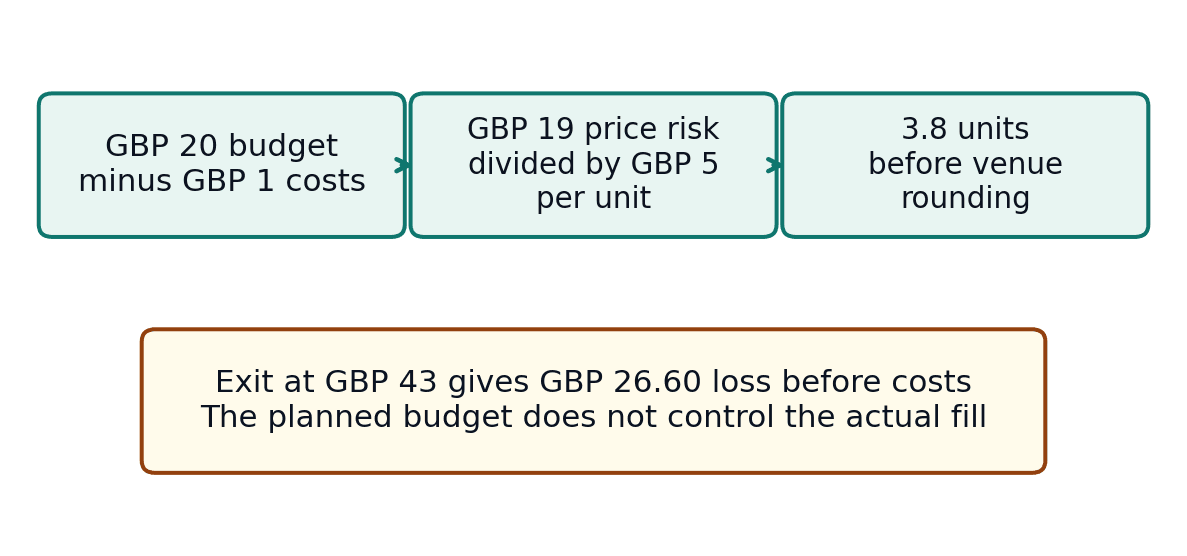
Read diagram as text
GBP 20 budget minus GBP 1 costs leaves GBP 19 for price risk.
GBP 19 ÷ GBP 5 risk per unit = 3.8 units before venue rounding.
An exit at GBP 43 gives GBP 26.60 price loss in the supplied example, before costs. A planned budget does not control the actual fill.
Use consistent account and quote currencies
If prices are in USD and the budget is in GBP, convert consistently. Under a supplied fixed assumption of GBP 0.80 per USD, a USD 5 price distance is GBP 4 per unit. A GBP 20 budget before costs then permits five units by arithmetic, not four. The conversion rate can change between entry and exit, so a static illustration does not remove currency risk.
PipStart's Crypto Position Size Calculator can illustrate a compatible simple price-distance example. Use the calculator only within its documented spot assumptions and verify units manually. The Risk Reward Calculator can compare planned reward and risk distances, but the ratio does not determine win probability or actual execution. Contract multipliers, inverse settlement and lending liquidations require their own worksheets.
Stress the planned exit
If the 3.8-unit holding exits at GBP 43 instead of 45, the price loss becomes GBP 26.60 before costs. Gaps, disappearing liquidity, outages and provider failure can prevent the assumed exit. An invalidation condition can occur without an order filling. A wallet or exchange becoming inaccessible introduces a different failure from ordinary price distance.
Stress the plan using adverse fills and total loss of the holding. Record what action is possible and what remains uncertain. A small calculated size is useful only when the learner understands its scope. The next lesson examines leverage, where a position larger than its supporting margin creates a different relationship between price movement and account equity.
Section 4 of 4
Everyday example, practice and review
Try the following questions aloud or on paper before opening the worked answers. Compare your reasoning as well as your final answer.
Try it yourself
Try each question on paper or explain your answer aloud before opening the worked answers. This practice is for learning; it is not scored.
1. Round the table’s 3.8-unit result down if only whole units are permitted.
2. At an exact GBP 45 exit, calculate the price loss on three units.
3. Convert USD 5 per-unit risk to GBP at the supplied GBP 0.80 per USD.
Compare with the worked answers
Worked answers
1. Three units. Four units would use GBP 20 of price risk before the reserved costs.
2. Three times GBP 5 equals GBP 15, before costs.
3. USD 5 × GBP 0.80 per USD = GBP 4 per unit. Both currencies must be labelled.
Quick knowledge check
Try each question on paper or explain your answer aloud before opening the worked answers. This practice is for learning; it is not scored.
Does the position-size output guarantee the maximum realised loss?
Compare with the worked answers
Worked answers
No. It depends on entry, exit and cost assumptions. Adverse fills, outages and other failures can produce larger losses.
What to remember
✓ Choose the boundary before solving for quantity.
✓ Committed capital and planned price loss are different amounts.
✓ Round and convert units consistently.
Lesson completion check
References and further reading
References
CFTC: Understand the Risks of Virtual Currency Trading ↗
Coinbase: Advanced trade order types ↗
Financial Conduct Authority: Financial Conduct Authority — Cryptoassets ↗