Stablecoins and What the Peg Promises
Section 1 of 3
Why stablecoins exist and how designs differ
Your learning goal
Evaluate the stabilisation mechanism and the actual redemption route.
A stablecoin aims to track a reference value. The word stable describes a target, not a guarantee about custody, reserves or your ability to redeem. We will separate the market price from the issuer's promise and examine how a token intended to equal one dollar can still expose a learner to several kinds of loss.
Key idea
Ask how this particular holder can turn this particular token into usable value.
Education only. Crypto assets can lose substantial value or become worthless. No lesson requires buying an asset, depositing money or sharing real passwords, private keys or recovery words.
See what a stablecoin is trying to do
Think of a token you buy at a funfair in Brisbane. You hand over A$10 and get ten tokens, each meant to be worth A$1 at any stall. At the end of the day you can swap unused tokens back for cash at the booth. The tokens are only as good as the booth's promise and the cash in its till.
A stablecoin is a crypto token built on that idea. It aims to keep a steady value, usually one US dollar, while moving on a blockchain like any other token. You met USDT in the exchange and order lessons in Level 3 as the quote currency in BTC/USDT. People use stablecoins to hold a dollar-like balance on an exchange without leaving crypto, to move value between providers, and for some payments.
Coinbase's learning centre makes the same point: there is no guarantee that a stablecoin will keep a stable value, or that reserves will cover every redemption. Where the funfair analogy stops working is scale and speed. A funfair booth serves a few hundred people. A stablecoin can be held by millions, traded around the clock and sold in seconds, so a loss of confidence spreads fast.
Stablecoins differ in what stands behind the promise. There are three main designs, and the most common keeps ordinary money in reserve.
Follow a fiat backed stablecoin from mint to burn
A fiat-backed stablecoin is backed by reserves of ordinary money and similar assets, such as bank deposits and short-term government bonds. Kraken's learning centre names USDT (Tether) and USDC (USD Coin) as examples. Naming them describes the category and is not a recommendation.
The mechanism works like the funfair booth. When an approved customer sends dollars to the issuer, the issuer creates, or mints, the same number of new tokens. When a customer returns tokens to the issuer for dollars, the issuer destroys, or burns, them. Kraken explains that minting and burning keep supply in line with demand. Many holders never deal with the issuer; they buy and sell on exchanges, where the market price usually stays close to US$1 because traders can profit from closing any gap.
The weak point is the reserve. If it is smaller, riskier or harder to reach than claimed, the promise weakens. Some designs try to avoid trusting a company by using crypto as collateral instead.
Look inside a crypto backed stablecoin
Imagine a pawnshop in Naples that lends you €100 only if you leave a watch worth €150. The extra value protects the lender if the watch's price falls.
A crypto-backed stablecoin works like that pawnshop. Users lock crypto as collateral in programs on a blockchain (called smart contracts, which Level 4 explains) and mint stablecoins against it. Because crypto prices swing, the collateral must be worth more than the stablecoins issued. Kraken calls this over-collateralisation. The best-known example is DAI, a crypto-collateralised stablecoin launched by MakerDAO, with single-collateral DAI in 2017; Maker has since rebranded parts of its ecosystem as Sky.
Collateral ratio = value of collateral ÷ value of stablecoins issued × 100%The pawnshop analogy has a limit. A pawnbroker can wait for a buyer. On a blockchain the sale happens automatically, and in a crash many sales happen at once. Over-collateralisation buys safety with capital. The third design tried to do without collateral, with famous results.
Learn from the collapse of Terra s UST
Picture a village in Andalusia where people trust that "village credits" can always be swapped for one euro's worth of shares in the village co-operative. That works while the shares are valuable. If everyone rushes to swap at once and the shares lose value, the promise collapses on itself.
An algorithmic stablecoin relies on rules and a second token rather than reserves. Terra's UST was the best-known. According to the SEC's February 2023 charges against Terraform Labs and its founder Do Kwon, the company claimed UST would hold its dollar peg because it could be exchanged for Terra's other token, LUNA. It also advertised returns of as much as 20% on UST through a related service called the Anchor Protocol.
In May 2022 the algorithmic stablecoin UST lost its US dollar peg and LUNA collapsed; tens of billions of US dollars in value were wiped out. The SEC said the prices of UST and related tokens fell close to zero. As holders swapped UST for LUNA, new LUNA flooded the market, its price fell, and confidence in the swap promise fell with it, a spiral Kraken's learning centre calls a "death spiral". The SEC alleged that Terraform and Kwon had misled investors about UST's stability.
Terra shows what happens when the backing disappears. For coins that do hold reserves, the next question is how you know.
Hybrids can combine features, so these categories are useful guides rather than complete diagnoses.
Section 2 of 3
Peg evidence, market sales and direct redemption
Peg market price and reserve evidence
A peg is a target relationship, such as one token intended to track USD 1. The market price is what buyers and sellers currently exchange. Reserves are assets held under a stated arrangement. These are distinct facts. A token can trade below its target even when the issuer reports reserves, because holders face eligibility, settlement, liquidity or confidence constraints.
Read reserve composition, custodians, report date and the scope of verification. A past report does not establish present availability, all liabilities or immediate redemption for every holder. Also distinguish a token backed by a claim on another token from one backed by direct eligible reserves. The additional layer can transmit the other token's failure. Good analysis identifies both economic backing and the legal route available to the particular holder.
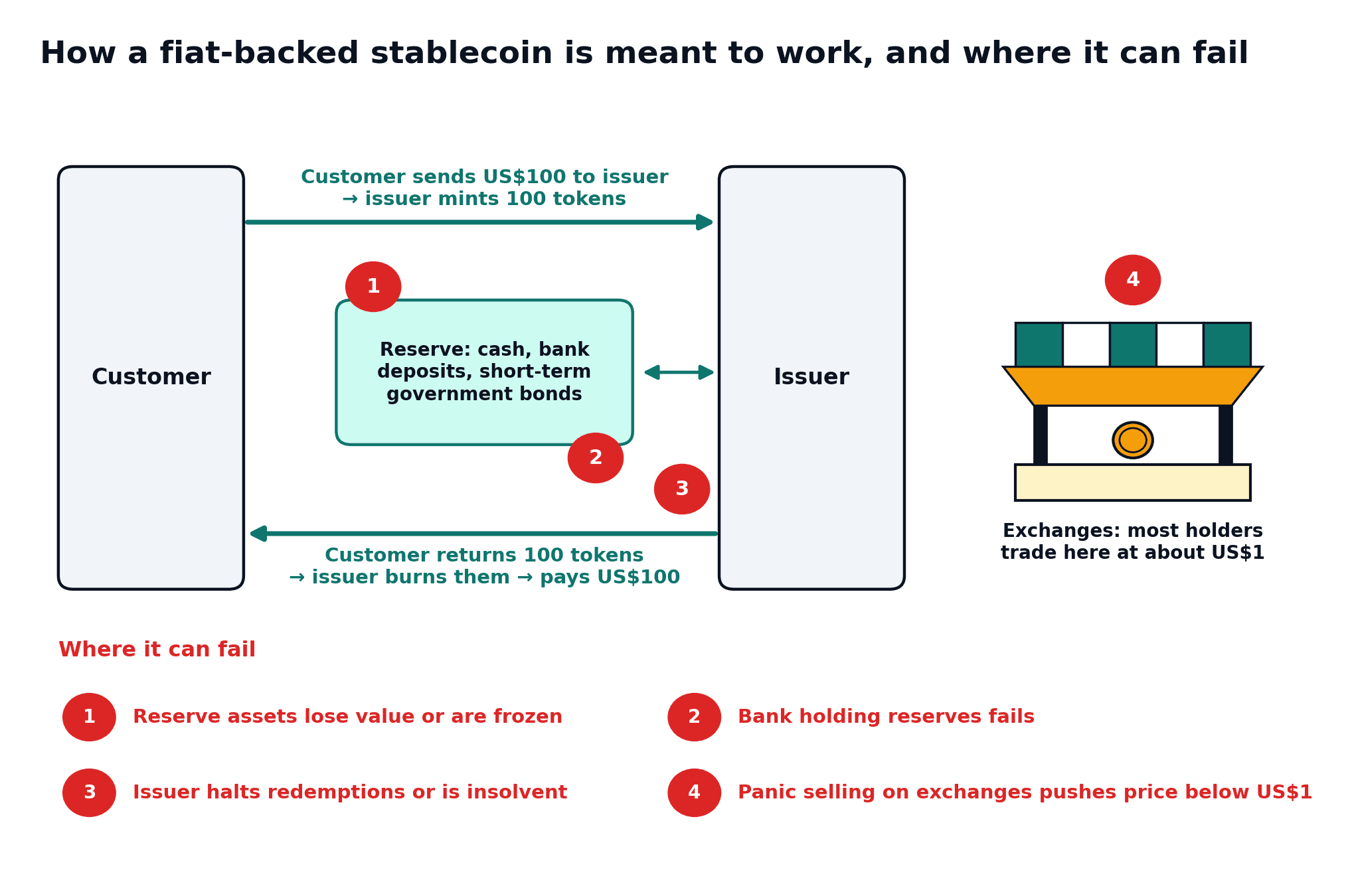
Read diagram as text
In this simplified arrangement, the customer sends USD 100 to the issuer, which mints 100 tokens. Eligible redemption returns 100 tokens for burning and USD 100 payment.
The reserve box lists cash, bank deposits and short-term government bonds. Most holders trade through exchanges rather than redeeming directly.
Marked failures: reserves lose value or freeze; the reserve bank fails; the issuer halts redemption or is insolvent; or exchange panic selling pushes price below USD 1.
Selling and direct redemption
Selling on an exchange means accepting another trader's bid, with venue fees and liquidity limits. Redeeming from an issuer means using the issuer's stated process to exchange eligible tokens for a specified asset. Direct redemption may require an approved account, particular jurisdictions, minimums or other conditions. A retail holder may have access only to market selling rather than a direct issuer facility.
For a particular product, read current terms and avoid generalising one issuer's rights to all stablecoins. Circle's published USDC terms, for example, describe eligibility and conditions rather than an unconditional bank-style cash withdrawal for every person holding the token. The course uses that as an example of why holder-specific terms matter, not as a recommendation.
Questions behind a stablecoin label
| Question | Evidence to inspect | Possible limit |
|---|---|---|
| What supports the peg | Reserve or collateral mechanism | Backing can change or weaken |
| Who can redeem | Current legal and account terms | Retail holder may be ineligible |
| Who can freeze | Contract and issuer powers | Transfers may be blocked |
| Which representation is held | Network and contract identity | Wrapper introduces extra dependencies |
| What price is available | Executable market depth | Target is not a guaranteed bid |
| What protection applies | Applicable local law and product terms | No automatic deposit insurance |
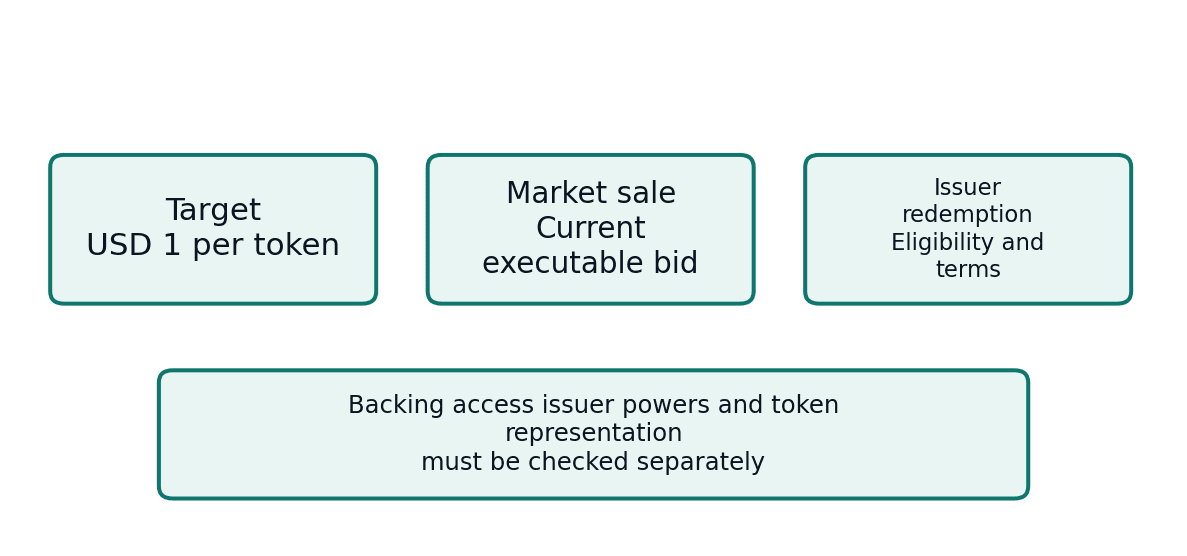
Read diagram as text
Target: USD 1 per token. Market sale: the current executable bid. Issuer redemption: eligibility and actual terms.
A lower box requires separate checks of backing, access, issuer powers and token representation. None automatically provides bank deposit protection.
Section 3 of 3
Depegs, dependencies and a stablecoin checklist
Depegs freezes and network dependencies
Imagine a shop voucher in Johannesburg worth R100 at the issuing store. If rumours spread that the store is in trouble, people may sell their vouchers to others for R90. The voucher still says R100, but the market says otherwise.
A depeg is the same thing for a stablecoin: its market price moves away from its target. The BIS argues that stablecoins struggle with what it calls "singleness": because each is a claim on a different issuer, different stablecoins can trade at a discount or a premium depending on how much people trust each issuer. Its report shows stablecoins regularly trading away from parity.
Loss from selling during a depeg = number of tokens × (US$1 − market price)Depegs are one reason governments have started writing rules specifically for stablecoins.
Issuers or contract administrators may have powers to freeze, block or alter specified operations. A genuine asset on one supported chain and a bridged version elsewhere may have different failure paths. Stability of the displayed price does not prove stability of access.
A complete stablecoin checklist
Record the reference asset, design, reserves or collateral, issuer powers, direct-redemption eligibility, network, contract, market liquidity and custody. Then ask what happens during a reserve problem, bank delay, frozen address or bridge failure. A useful conclusion can be that the product does not fit the planned purpose, even if it has maintained the target recently.
Do not treat a stablecoin as automatically insured cash. Bank deposit protection, where applicable, has specific beneficiaries and conditions; it does not arise simply from a dollar label. For a learner measuring trades in a stablecoin, both the traded asset and the quote token contribute risk. Later portfolio and DeFi lessons will revisit this shared dependency.
Everyday example
Try it yourself
Try each question on paper or explain your answer aloud before opening the worked answers. This practice is for learning; it is not scored.
1. Value 250 tokens at USD 0.96 before costs.
2. Why might issuer reserves not guarantee your immediate redemption?
3. Name one extra risk introduced by a bridged representation.
Compare with the worked answers
Worked answers
1. 250 × 0.96 equals USD 240, a USD 10 difference from the USD 250 target value.
2. Eligibility, jurisdiction, minimums, account approval, reserve availability and operational terms may limit the holder's route.
3. Bridge custody, contract failure, operator behaviour or redemption limits can affect the representation independently of the underlying token.
Quick knowledge check
Try each question on paper or explain your answer aloud before opening the worked answers. This practice is for learning; it is not scored.
Is market sale at the current bid the same as direct issuer redemption?
Compare with the worked answers
Worked answers
Answer. No. They involve different counterparties, prices, conditions and access rights.
What to remember
Key points
✓ A peg is a target relationship.
✓ Reserves and your redemption rights must both be examined.
✓ A stable quote can conceal access or wrapper risk.
Lesson completion check
Check what you know
References and further reading
References
SEC Investor.gov: Crypto Asset Custody Basics for Retail Investors ↗