Read a Spot Market and an Order Book
Section 1 of 3
Trading pairs, bids, asks and spread
Base and quote units
Your learning goal
Explain a quoted pair, spread and order-book depth without confusing price with a guaranteed fill.
A displayed price is not necessarily the price for your whole order. A spot market contains quantities offered at different levels. Understanding those levels explains why a larger purchase can cost more per unit than a small one. We will read a fictional order book and calculate the average execution instead of assuming every unit trades at the top price.
Key idea
Calculate total quote cost first, then divide by the filled base quantity.
Education only. Crypto assets can lose substantial value or become worthless. No lesson requires buying an asset, depositing money or sharing real passwords, private keys or recovery words.
In BTC/GBP, BTC is the base asset whose quantity is traded, while GBP is the quote currency used to state its price. A price of GBP 40,000 means GBP 40,000 per one BTC. In BTC/USDC the quote asset is a stablecoin, so the number is USDC per BTC rather than automatically bank dollars. Both assets and their units matter.
Quantity multiplied by price gives quote value before fees. Buying 0.01 BTC at GBP 40,000 costs GBP 400 before additional costs. An order entry field may ask for base quantity or quote spending amount; confusing the two can produce an unwanted order. Read the units beside the field and the preview. Market pairs also differ across venues, and a home-currency valuation may require another conversion after the trade.
Read bids asks and spread
Imagine a noticeboard at a phone market in Seoul. Buyers pin cards saying "I'll pay ₩400,000"; sellers pin cards saying "I'll sell for ₩420,000". Nobody trades until two cards agree.
An order book is that noticeboard. Kraken's trading glossary describes it as a list of unfilled buy and sell limit orders. Buy orders are bids and sell orders are asks. The highest bid and the lowest ask sit closest together, and the gap between them is the spread.
Every market is a trading pair. In BTC/USDT, the first asset (BTC) is the base and the second (USDT, a dollar-pegged token you'll meet in the stablecoin and transfer lessons in Level 3) is the quote. The price tells you how many units of the quote buy one unit of the base. A pair such as ETH/BTC prices ether in bitcoin, with no national currency involved.
| Side | Price (USDT) | Size (BTC) |
|---|---|---|
| Ask | 50,400 | 0.5 |
| Ask | 50,200 | 0.3 |
| Ask (best) | 50,100 | 0.2 |
| Bid (best) | 49,900 | 0.3 |
| Bid | 49,800 | 0.4 |
| Bid | 49,600 | 1.0 |
The best bid is 49,900 and the best ask is 50,100, so the spread is 200 USDT. A narrow spread with plenty of size at each level marks a liquid market, where trading costs less; thin books cost more. What you pay also depends on your order type.
A top ask of GBP 100 with only two units available does not mean five units can all be purchased at GBP 100. Treat a displayed book as a changing view of a particular venue rather than a guaranteed inventory lasting until your click.
Section 2 of 3
Calculate a fill across book levels
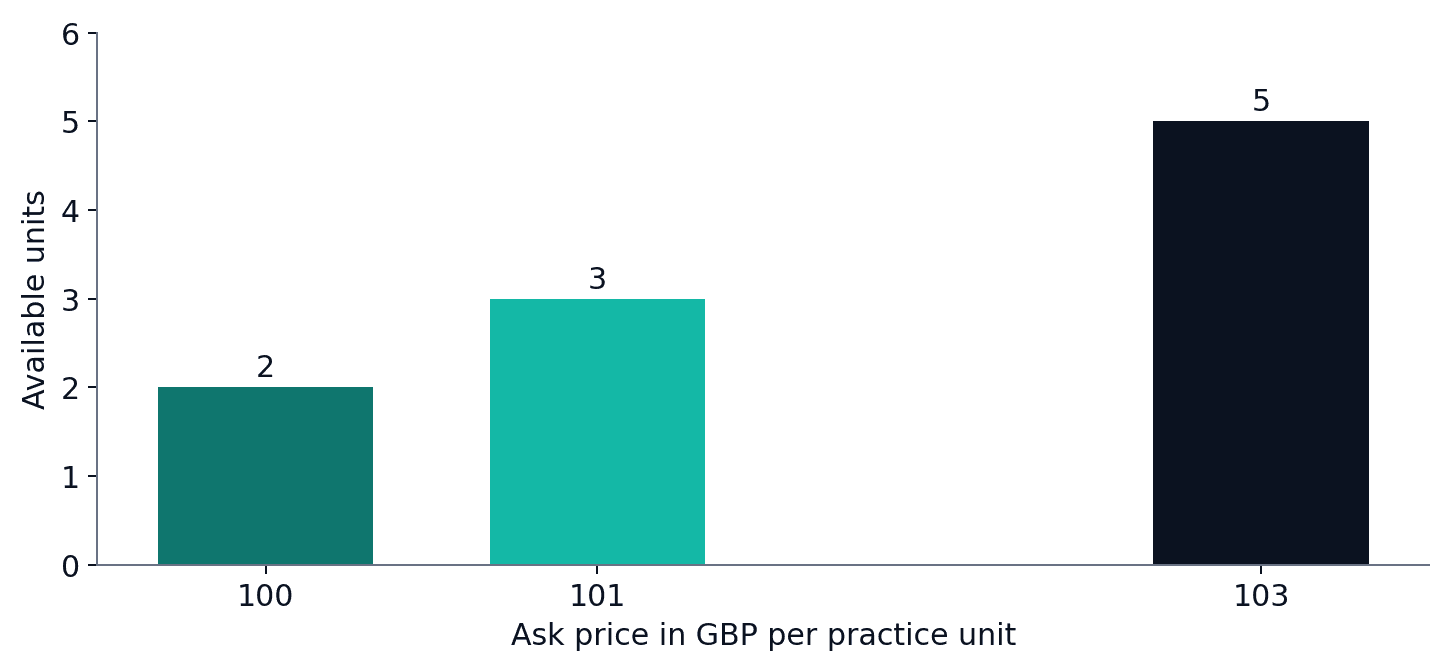
Suppose asks offer two units at GBP 100, three at GBP 101 and five at GBP 103. A fictional immediate purchase of four units takes two at GBP 100 and two at GBP 101, assuming no changes and no other orders. The quote cost is GBP 200 plus GBP 202, or GBP 402. Dividing by four units gives a quantity-weighted average of GBP 100.50.
An ordinary average of the price levels is inappropriate because the filled quantities differ. A larger six-unit purchase would use two at GBP 100, three at GBP 101 and one at GBP 103, costing GBP 606 and averaging GBP 101. The book itself explains why order size changes the average. Trading fees are then applied under the venue's rules; they are not already included in this simplified calculation.
Walk a four unit purchase through the asks
| Ask price | Available units | Units bought | Quote cost |
|---|---|---|---|
| GBP 100 | 2 | 2 | GBP 200 |
| GBP 101 | 3 | 2 | GBP 202 |
| GBP 103 | 5 | 0 | GBP 0 |
| Total | — | 4 | GBP 402 |
Average fill is GBP 402 divided by 4, or GBP 100.50. The book is fictional and assumed unchanged.
Imagine buying ten loaves at a bakery in Rome with only three left at the shelf price. The next batch costs more, so your average price ends up above the label.
Read diagram as text
Fictional available asks: GBP 100 has 2 units; GBP 101 has 3 units; GBP 103 has 5 units.
Buying 4 units consumes 2 × GBP 100 plus 2 × GBP 101 = GBP 402, averaging GBP 100.50 per unit before fees.
The illustration assumes displayed depth stays available. Real orders can cancel or move before a fill.
Section 3 of 3
Liquidity and your executable price
Liquidity and separate markets
Liquidity is the ability to buy or sell a relevant quantity with limited disruption and acceptable execution conditions. It depends on depth, spread, turnover, participation and how the book responds during the order. High advertised volume does not guarantee useful depth at your size. Volume may also contain activity that does not represent independent end-user demand.
Crypto liquidity is distributed across venues, pairs and networks. An attractive quote elsewhere may be inaccessible because of fees, funding delays, custody restrictions or regional eligibility. During stress, orders can vanish and transfers can slow. Compare executable depth for the intended route rather than assuming all global volume is available to you. Later token research uses this distinction to test whether a quoted portfolio can realistically be sold near its displayed value.
Depth is a snapshot, not a reservation. Other traders can remove orders before yours arrives, and displayed quantities can be cancelled or replenished. Hidden orders and venue matching rules can also affect a fill. An apparently thick book in a screenshot may therefore offer less executable liquidity later.
Compare size with the actual levels it would consume. A market quote for one unit and a market quote for one thousand units answer different questions. If two venues show different prices, moving assets between them adds withdrawal timing, fee and custody dependencies; the difference is not automatically an available profit.
A last price is not your executable price
The last trade price records a completed trade, perhaps for a very small quantity. An indicative quote may be a preview under assumptions. The executable result depends on the orders available when your action reaches the venue and the instructions you use. A chart line based on last trades is useful history, but it is not a standing offer for your entire holding.
Before placing an order, specify size, expected execution, fee assumptions and the maximum acceptable difference where relevant. After execution, compare actual fills with the expectation. This difference leads into slippage, price impact and order types in the next lesson. A careful beginner records quantities and fills rather than saying simply that the price was 100.
Everyday example
Try it yourself
Try each question on paper or explain your answer aloud before opening the worked answers. This practice is for learning; it is not scored.
1. Using the same asks, calculate the cost and average price for six units.
2. What is the spread if the best bid is GBP 99 and best ask GBP 100?
3. Why might a last trade at GBP 100 be unsuitable for valuing an immediate sale of 100 units?
Compare with the worked answers
Worked answers
1. Cost is 2 × 100 + 3 × 101 + 1 × 103 = GBP 606. Average is GBP 101 per unit before fees.
2. GBP 1 per unit. As a percentage, the reference denominator must be specified.
3. The last trade may be small; available bids at that size may be lower and change during execution.
Quick knowledge check
Try each question on paper or explain your answer aloud before opening the worked answers. This practice is for learning; it is not scored.
Should average fill be the unweighted average of every displayed price level?
Compare with the worked answers
Worked answers
Answer. No. Weight only actual fills by their quantities. Unused levels do not enter the cost of the completed order.
What to remember
Key points
✓ Prices need base and quote units.
✓ Depth determines the simplified fill for an order size.
✓ Last trade and executable price are different observations.
Lesson completion check
Check what you know
References and further reading
References
Coinbase: Advanced trade order types ↗
Kraken: What are Maker and Taker fees ↗
CFTC: Understand the Risks of Virtual Currency Trading ↗