Connections, Signatures and Token Permissions
Section 1 of 3
Connections, signatures and token allowances
Connection, message, transaction and approval
Your learning goal
Identify the authority granted by a wallet request before accepting it.
Connecting a wallet is not the same as granting spending permission. Signing a message is not always harmless, and disconnecting a website does not necessarily remove an existing allowance. This lesson separates the actions that interfaces often place close together, then shows how to review permissions without confusing a tidy browser session with secure on-chain authority.
Key idea
The most useful question is what another party can do after this approval.
Education only. Crypto assets can lose substantial value or become worthless. No lesson requires buying an asset, depositing money or sharing real passwords, private keys or recovery words.
Connecting commonly lets a site see a selected public account and request further interactions. A message signature authorises or attests to specific data; its practical effect depends on the message and protocol. A signed transaction asks the network to perform an action. A token approval can give a specified spender permission to transfer an asset under the token contract's rules.
The interface may describe all four with a simple approve button, so read the underlying request. Connecting alone commonly does not transfer assets, but it can expose an address and invite deceptive prompts. A signature may be used to submit an order or permission later. A transaction can call several contracts, so its effect may be broader than a basic payment. Your task is to identify the authority being granted, rather than judging risk by the button's colour.
Token allowances and their scope
For an approval, identify the owner account, token, spender and permitted amount. The spender is often a contract, not the website's display name. An unlimited or very large allowance can remain after one intended swap. If the spender is malicious or later compromised, the unused authority may matter. Some permission schemes also specify deadlines or other limits; others persist until changed.
An approval does not by itself guarantee an immediate transfer, but it establishes authority that may enable one. Reducing the allowance to the amount needed can limit one type of exposure where the product supports it. It does not certify the underlying transaction or contract as safe. Read the exact action and current implementation, including whether a separate signature-based permission mechanism is involved.
Think about a direct debit with a gym. Instead of paying each month, you give the gym permission to take payments. If the gym is honest, that is convenient. If its systems are hacked, or it turns dishonest, the same permission lets money leave without you pressing anything.
Section 2 of 3
Permit signatures and other delayed authority
Imagine signing a permission form at home and posting it to someone. Your bank has no record of it until that person hands it in.
Some tokens support a feature called permit, defined in EIP-2612. Instead of sending an approve transaction, you sign an approval message off the blockchain, for free. The app submits your signature with its own transaction, and at that moment the approval takes effect. Used honestly, this saves a separate fee and makes limited approvals more practical.
The risk is that a permit request can look like a harmless log-in. revoke.cash points out that wallets often warn clearly about on-chain approvals but less clearly, or not at all, about signature requests. A scam site can ask for a permit for all your tokens, then submit it at once and drain them. Because the signature stays off-chain until used, approval checkers cannot see it in advance, and cancelling it means beating the scammer with an on-chain transaction.
If a signature request names a spender, an amount or a deadline, it is a permission, not a greeting. Now put fees and permissions together in practice.
Imagine a stranger at a festival offering free drinks if you sign a "guest list" that is really a form handing over your bank card.
A wallet drainer works like that form. Chainalysis describes drainers as phishing tools posing as genuine crypto projects, often with "free token" offers promoted through chat communities and hacked social media accounts. Victims connect their wallet and approve a request that hands the operator control of their funds. Chainalysis gives the example of a drainer imitating a well-known marketplace that had taken about US$500,000 in more than 1,000 malicious transactions by April 2024.
The festival analogy has a limit. A paper form can be torn up later. A signed blockchain request can act at once, cannot generally be reversed once confirmed, and some kinds stay active after you leave the site. Reviewing and revoking permissions is the next part of this lesson. Level 4 builds on these foundations when you study smart contracts.
Next, separate leaving a website from cancelling the authority you granted.
However, a signed message can authorise a valuable action that another party submits later, such as an order or token permission. If the wallet cannot decode a request clearly, do not infer that it is safe because the site looks familiar. Check the domain independently, identify the intended action and decline anything you cannot explain. Do not sign a request merely to prove eligibility for a reward. A promotion is not a reason to grant unexplained authority over a wallet.
Section 3 of 3
Disconnection, revocation and permission review
Disconnection is different from revocation
Disconnecting usually removes a site's current connection to the wallet interface. It may stop routine account sharing and new requests through that connection. It does not generally modify an existing token allowance recorded on-chain. Revocation changes that allowance through an appropriate authorised action and may require a network fee. These are different operations.
Closing a browser tab has similar limits. The ledger is not changed just because a local window disappears. Some signatures or protocol permissions need their own cancellation process, and not every authority can be neutralised through a generic allowance tool. Keep a record of significant permissions and review their actual scope using verified sources. A clean list of connected sites is not proof that no spender retains authority.
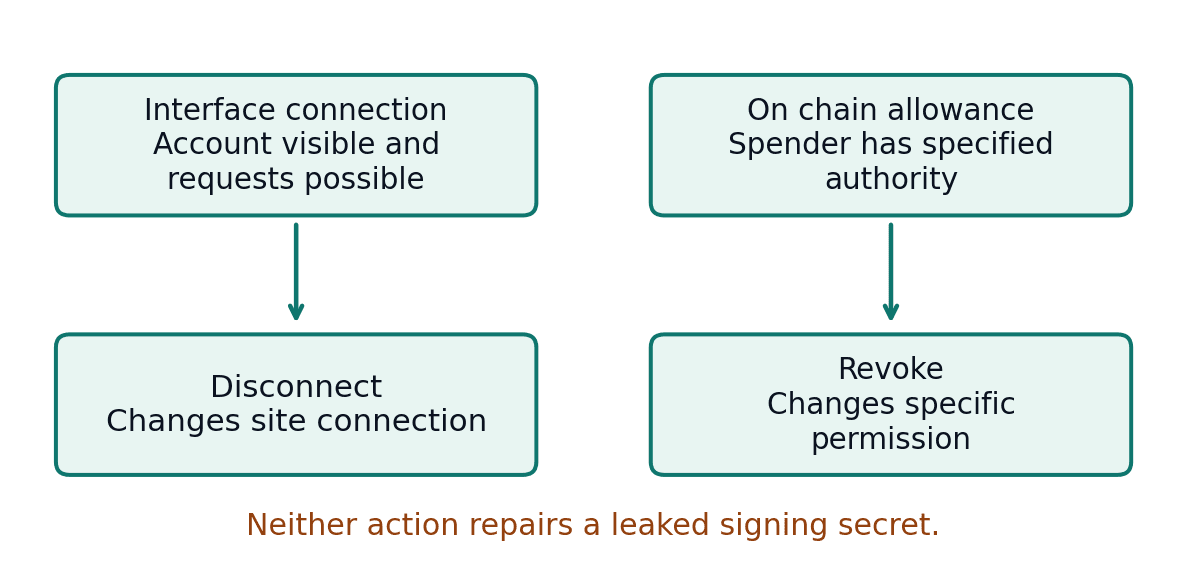
Read diagram as text
Interface connection makes the account visible and permits requests. Disconnect changes that site connection.
An on-chain allowance grants a spender specified authority. Revoke changes the relevant permission, using its actual mechanism.
Neither action repairs a leaked signing secret.
Review permissions and understand the limit
Reach permission-review tools through independently verified routes, and inspect the network and account being reviewed. A fake revocation site can ask for new harmful permissions. Read the transaction before approving it, and check the resulting status. If the problem is a copied key or recovery phrase, revoking one allowance is inadequate because the attacker still has broader signing authority.
Permission review is therefore part of a wider diagnosis. Ask whether the issue is an unwanted spender, an exposed secret or a compromised service login. The next lesson uses that diagnosis to select a response. A precaution that works for one category must not create false reassurance about another. No exercise here requires connecting a funded wallet or visiting an unfamiliar revocation service.
Everyday example
Try it yourself
Try each question on paper or explain your answer aloud before opening the worked answers. This practice is for learning; it is not scored.
1. Contract B has a 500-unit allowance. You close its website. What allowance should you assume remains until verified otherwise?
2. Why can a message signature be important even with no gas charge?
3. When is moving to independent secure signing authority more relevant than revoking one spender?
Compare with the worked answers
Worked answers
1. The 500-unit allowance can remain. Closing or disconnecting the site does not generally change it.
2. The message may be used later to authorise an order or permission. No immediate network fee does not mean no economic effect.
3. When the private key or recovery material is exposed. The attacker may create new permissions or direct transfers using that authority.
Quick knowledge check
Try each question on paper or explain your answer aloud before opening the worked answers. This practice is for learning; it is not scored.
Does revoking a token allowance make a copied private key safe again?
Compare with the worked answers
Worked answers
Answer. No. Revocation changes a specific permission; it does not erase the attacker's copy of signing authority.
What to remember
Key points
✓ Name the action and authority before approving.
✓ Check spender and amount rather than display name alone.
✓ Disconnection and revocation are different operations.
Lesson completion check
Check what you know
References and further reading
References
MetaMask: What is a token approval ↗
MetaMask: Disconnect wallet from a dapp ↗
MetaMask: I have been hacked or scammed ↗
Ethereum: Ethereum security and scam prevention ↗
Federal Trade Commission: Federal Trade Commission — SIM swap scams: how to protect yourself ↗
FBI IC3: FBI IC3 — North Korea responsible for US$1.5 billion Bybit hack (26 February 2025) ↗
Ledger Academy: Ledger Academy — What is blind signing? ↗
Trezor: Trezor — Trezor's Trusted Display: verify every address on your device ↗
ethereum.org: ethereum.org — Gas and fees ↗
ethereum.org: ethereum.org — ERC-20 token standard ↗
ethereum.org: ethereum.org — ERC-721 non-fungible token standard ↗
Ethereum: EIP 7702 Set Code for EOAs ↗