What Is Bitcoin
Section 1 of 5
Why copying money is a problem
Your learning goal
Explain Bitcoin's purpose and early history without assuming it solves every payment problem.
Bitcoin is both the name of a network and, in ordinary conversation, the name of the asset used on that network. The system is easier to understand when you separate those meanings. First examine the payment problem it was designed to address. Then look at the rules that define the asset. Its history explains the design, while its current usefulness and price require their own evidence.
Key idea
Study the network rules and the market asset as related but different subjects.
Education only. Crypto assets can lose substantial value or become worthless. No lesson requires buying an asset, depositing money or sharing real passwords, private keys or recovery words.
Start in 2008 when trust in banks was shaken
Inventions make more sense once you know what was happening when they appeared. Bitcoin's design was published in the autumn of 2008, in the middle of the worst financial crisis many people alive had seen.
The US Federal Reserve's own history describes December 2007 to June 2009 as the longest recession since the Second World War. Housing was at the centre of it: US home prices fell by about 30% from mid-2006 to mid-2009, and US unemployment peaked at 10%. Governments and central banks stepped in with rescue packages, near-zero interest rates and large asset purchases.
For ordinary people, the crisis raised an uncomfortable question. Your savings sit in a bank, and the bank's records say how much is yours. What happens when the institutions keeping those records get into trouble? Many people began to wonder whether money had to depend so heavily on a few trusted middlemen.
Bitcoin's creator seems to have had that question in mind, as a newspaper headline hidden in Bitcoin's first block will show. But the crisis did not invent the idea of digital cash. People had been trying to build it for decades, and to see why they kept failing, you need to meet the problem that blocked them.
See why digital money is hard to make
Think about a ¥1,000 note in your wallet. Once you hand it to a shopkeeper, it has left your hand, and you cannot give the same note to someone else. Physical cash solves the "spend it once" problem without anyone checking.
Digital things behave differently. A photo or a document is a string of data, and data can be copied perfectly. That is wonderful for holiday pictures and a disaster for money.
A file can show what it is, but on its own it cannot prove that it hasn't already been given to someone else. Somebody has to keep track. For most of the history of digital payments, that somebody has been a bank.
Notice how banks solve the problem today
When you pay with a bank card or app, you are not sending a file of money. You are asking your bank to change two numbers in a record it controls: yours goes down, the shop's goes up. Because the bank holds the only official record, a second attempt to spend the same balance is refused.
This can bring benefits. If the shoes never arrive, Lucía may be able to dispute the payment under the applicable terms, and the bank can freeze stolen cards. It also has costs. The Bitcoin whitepaper pointed out that because banks must handle disputes, payments are never completely final, and the cost of that mediation is passed on as fees. Everyone also depends on the record-keeper staying honest, solvent and online.
So the challenge was clear: could people build digital cash with rules for rejecting conflicting accepted spends, without putting one company in charge of the record? Several brilliant people tried before Bitcoin.
If a digital money file worked that way, the sender could copy it and claim to pay two different shops with the same value. A signature can show that a spending instruction is authorised, but signatures alone do not tell everyone which of two conflicting instructions came first.
Section 2 of 5
The ideas before Bitcoin
Bitcoin grew out of a small online community of programmers and cryptographers, often called cypherpunks, who believed strong cryptography could change how money worked. Each of their experiments solved part of the puzzle.
| Project | Person | When | Main idea | What was still missing |
|---|---|---|---|---|
| DigiCash / eCash | David Chaum | 1980s–90s | Private digital payments using clever cryptography | A central company still issued the money and checked for double-spending; the company did not survive |
| Hashcash | Adam Back | 1997 | Make the sender do a small amount of computer work, to make spam costly | It was an anti-spam tool, not money, but the "costly work" idea became important |
| b-money | Wei Dai | 1998 | Everyone keeps a record of who owns what; money created through computer work | Stayed a proposal; never built as a working network |
| Bit Gold | Nick Szabo | proposed around 1998–2005 | "Unforgeable" units created by computer work, recorded in a shared title registry | Stayed a proposal; agreeing on one shared record was not fully solved |
Look at the pattern. DigiCash showed digital payments could be private, but kept a company at the centre. Hashcash showed that "proof of costly work" could be checked cheaply by anyone. B-money and Bit Gold imagined money living in a shared record with no central issuer; Szabo argued that money depending on a trusted third party is exposed to that party's failures.
Earlier research had already explored distributed agreement, digital cash and proof of work. Bitcoin combined such ideas into a working open network for recording and checking payments. A paper published on 31 October 2008 set out to provide that missing piece.
Section 3 of 5
Satoshi and the beginning of Bitcoin
Read the whitepaper of 31 October 2008
On 31 October 2008, someone using the name Satoshi Nakamoto posted a nine-page paper to an email list for people interested in cryptography. Its title was "Bitcoin: A Peer-to-Peer Electronic Cash System".
The paper's opening set out the goal plainly. Digital signatures already solved part of the problem, it said, but the main benefits are lost if a trusted third party is still needed to prevent double-spending. Its answer was to make the history of transactions public. Every payment would be announced to a network of computers that agree on one time-ordered record, so anyone receiving bitcoin could check the coins hadn't been spent before.
Participants who did the costly work of adding new pages to the record would be rewarded with new coins and fees. The whitepaper cites Wei Dai's b-money and Adam Back's Hashcash directly. You'll see how the shared record fits together in the next lesson, and how the costly work (mining) operates in the mining and fee lessons in Level 1.
Satoshi Nakamoto is a pseudonym whose real identity has not been reliably established in public. Yet the paper never asked readers to trust its author; its whole point was that you shouldn't have to. Within a few months, the idea moved from paper to working software.
Look inside the genesis block
In January 2009, the first Bitcoin software was released, and the network began. Its very first block of transactions, known as the genesis block, carries the date 3 January 2009.
Inside that block, Satoshi placed a line of text: "The Times 03/Jan/2009 Chancellor on brink of second bailout for banks". It was the front-page headline of the British newspaper The Times that day, about the UK government considering more help for struggling banks.
The headline did two jobs. It worked like a timestamp: a photo of someone holding today's newspaper cannot be older than that paper, and in the same way the block could not have been made before that date. It also read like a comment on why Bitcoin existed. Whatever Satoshi's exact intention, the link to the 2008 crisis is hard to miss.
One curious detail: the 50 bitcoin reward in the genesis block cannot be spent, because of the way the software treats that first block. The course does not infer a motive from this technical detail. The first block was symbolic; an early documented transfer between two people came days later.
Follow the first payment to Hal Finney
One of the first people to run the software was Hal Finney, a cryptographer from the same online community. In 2004 he had built RPOW (reusable proofs of work), which extended Hashcash so that pieces of "proof of work" could be passed from person to person.
On 12 January 2009, Satoshi sent 10 bitcoin to Finney. The payment was recorded in block 170 and is remembered as the first Bitcoin transaction between two people. Bitcoin had no market price at all then. It was a test between enthusiasts, showing the system did what the paper described.
The Bitcoin white paper appeared in 2008 under the name Satoshi Nakamoto. That name is pseudonymous; it does not establish a verified person's identity. It is a design document, not a promise of a rising price or a complete description of every feature added later. Historical attribution should therefore distinguish the original author, earlier research and subsequent development rather than inventing a single known founder with permanent control.
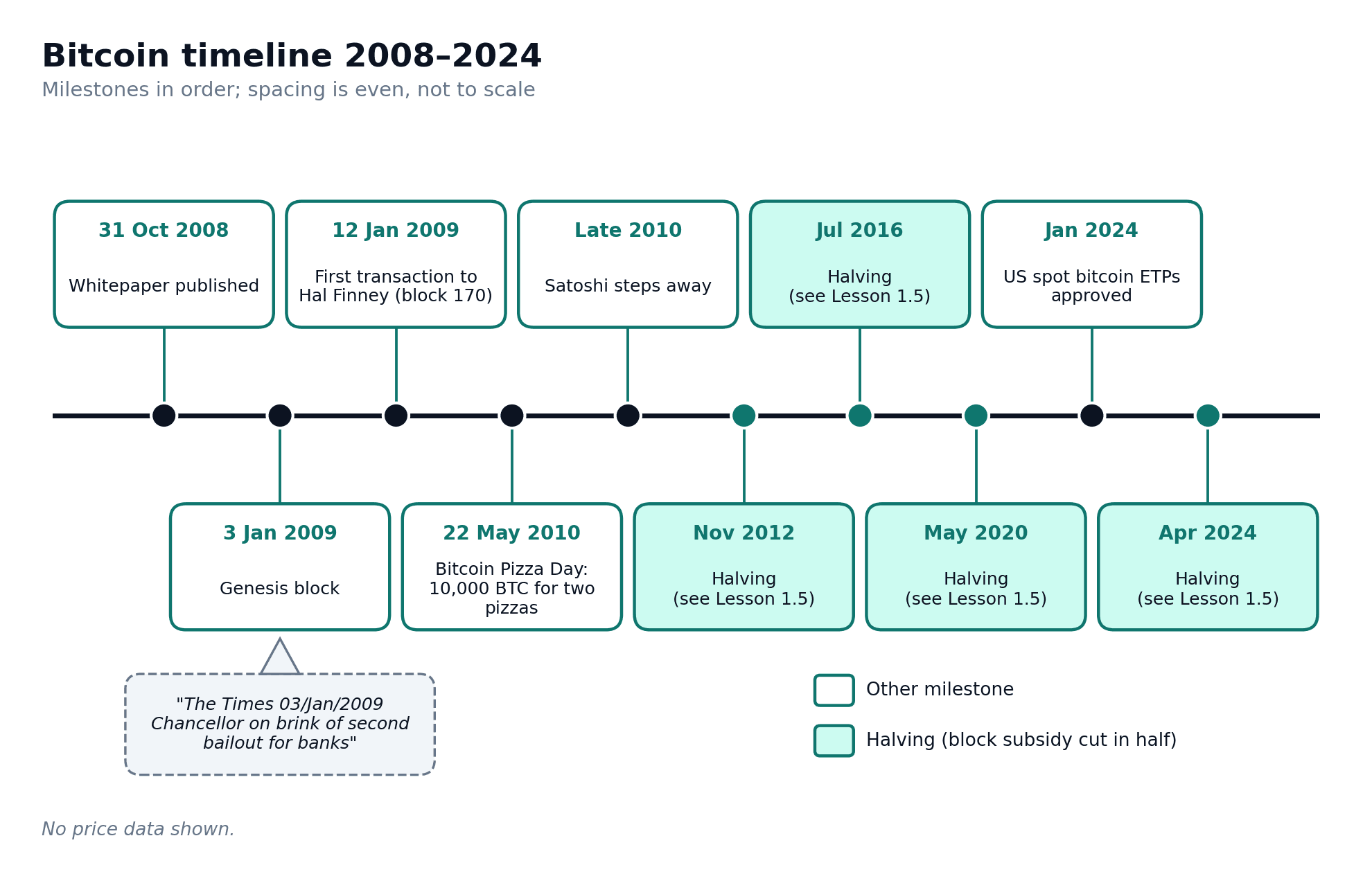
Read diagram as text
31 October 2008: white paper. 3 January 2009: genesis block. 12 January 2009: transaction to Hal Finney in block 170. 22 May 2010: 10,000 BTC for two pizzas. Late 2010: Satoshi steps away.
The halving milestones are November 2012, July 2016, May 2020 and April 2024. January 2024 marks US spot bitcoin ETP approval.
The genesis-block newspaper message reads: The Times 03/Jan/2009 Chancellor on brink of second bailout for banks. Spacing is schematic; no price path is shown.
Section 4 of 5
The network, the coin and early use
Count the cost of Bitcoin Pizza Day
For more than a year, bitcoin was mostly swapped between hobbyists. Then on 22 May 2010, a programmer named Laszlo Hanyecz paid 10,000 BTC for two pizzas. He had posted an offer online days earlier, and a forum user known as Jercos ordered the pizzas and received the bitcoin. It is recorded as the first documented purchase of a good with bitcoin. The coins were worth about US$41 at the time, and those two numbers show how little each bitcoin was worth that day.
Implied price per bitcoin = total value of the purchase ÷ number of bitcoin paidToday, 22 May is celebrated as Bitcoin Pizza Day, often told as a joke about "the most expensive pizzas ever". The more useful point is that bitcoin had become something people would accept for goods, which is what the whitepaper hoped for.
Pizza Day showed Bitcoin working as money. Soon after, the person who started it all stepped away.
Notice when Satoshi stepped away
According to bitcoin.org, Satoshi left the project in late 2010 without revealing much about themselves. Other volunteers carried on improving the software, and Bitcoin has kept running without its founder.
This shows something unusual about Bitcoin. There is no chief executive, head office or customer-service line. Bitcoin.org compares it to email: nobody owns the network, and developers cannot force changes onto everyone. Changes need broad agreement from the people running the software.
That brings freedom and responsibility. With a bank, someone can reverse a mistake. With Bitcoin, nobody can step in to undo a payment or restore lost access for you. The loss and safety lesson in Level 0 explained why such losses are often permanent, and the transaction and fee lessons in Level 1 will show how confirmations increase confidence in settlement.
With the founder gone and the network open to anyone, people were left to argue about what Bitcoin should become.
Wallets can display the same holding in BTC or satoshis, which may make the number look very different without changing its value. A denomination change does not change the holding.
Section 5 of 5
What Bitcoin can and cannot promise
Bitcoin can be used for transfers, held as an asset or studied as an example of distributed verification. Public participation and independent validation can be useful, particularly when a person wants to inspect rules rather than accept a provider's balance statement. These features have trade-offs: on-chain fees vary, confirmation takes time, and public records can reveal information when linked to people.
A merchant also has practical concerns. The merchant must decide how to price goods, handle refunds, manage exchange-rate movement and accept a confirmation policy. A BTC payment is not automatically cheaper or faster than every existing payment method. A service that makes the process convenient may introduce custody and provider dependence. Judge the actual route, including any conversion and service fees, rather than treating the network's general description as a complete retail payment comparison.
Bitcoin rules can let a validating participant reject an invalid spend or a block that violates those rules. They do not certify that a recipient is honest, that an exchange is solvent or that a purchase contract will be honoured. A correctly authorised payment to a fraudster can still be accepted by the network. Technical validity and a good economic decision are different questions.
Decentralisation also does not eliminate all concentration or outages. Mining, software distribution, internet access and service providers are separate dependencies. You can improve your understanding by asking which dependency matters for your activity. A learner reading an explorer, a merchant receiving payment and a customer leaving assets on an exchange rely on different arrangements. The next lesson examines how a full node checks the ledger rather than assuming every published record is trustworthy.
Everyday example
Try it yourself
Try each question on paper or explain your answer aloud before opening the worked answers. This practice is for learning; it is not scored.
1. Explain double spending without using the word blockchain.
2. Convert 0.0035 BTC to satoshis.
3. Name one thing the network can validate and one thing it cannot promise.
Compare with the worked answers
Worked answers
1. It is an attempt to spend the same available value more than once. A system needs consistent records to reject conflicting spends.
2. 0.0035 multiplied by 100,000,000 equals 350,000 satoshis.
3. It can check spending authorisation and transaction rules. It cannot promise a recipient will deliver goods or that a market price will rise.
Quick knowledge check
Try each question on paper or explain your answer aloud before opening the worked answers. This practice is for learning; it is not scored.
Is Satoshi Nakamoto a publicly verified personal identity?
Compare with the worked answers
Worked answers
Answer. No. It is the pseudonymous name associated with the 2008 white paper and early development. The course does not speculate about identity.
What to remember
Key points
✓ Bitcoin addresses double spending through rules and ordered history.
✓ BTC quantities and home-currency valuations describe different things.
✓ A valid transfer is not proof of a safe purchase.
Lesson completion check
Check what you know
References and further reading
References
Bitcoin community: Bitcoin A Peer to Peer Electronic Cash System ↗
Bitcoin community: Bitcoin FAQ ↗
MIT OpenCourseWare: Blockchain and Money ↗
NIST: Blockchain Technology Overview NISTIR 8202 ↗
Bitcoin community: Bitcoin Core Validation ↗
Ledger Academy: Ledger Academy — When Was Bitcoin Invented? The Complete History and Timeline ↗