Mining, Fees, Confirmations and Finality
Section 1 of 6
From broadcast to a waiting transaction
Your learning goal
Explain why a broadcast transaction and a settled payment are different stages.
A wallet can broadcast a transaction before it is confirmed. That gap matters when a payment is time-sensitive. This lesson follows a transaction from the waiting area to a block, explains how fees are measured, and shows why different recipients can require different confirmation counts. It also introduces fee replacement and Lightning without requiring a live transfer.
Key idea
Check network status and recipient crediting policy separately.
Education only. Crypto assets can lose substantial value or become worthless. No lesson requires buying an asset, depositing money or sharing real passwords, private keys or recovery words.
Picture a payment from start to finish
Earlier in the course you saw how blocks are chained together and checked by nodes. Now follow a single payment all the way into the chain.
Think about posting a letter. You write and sign it, drop it in a postbox, it waits at a sorting office, goes out for delivery, and is finally filed in an archive that grows thicker every day. A Bitcoin payment has a similar journey. Your wallet builds and signs the transaction and broadcasts it. It waits with other unconfirmed payments, gets included in a block, then sinks deeper as more blocks are added on top.
The postal analogy breaks down in one place: there is no post office in charge. Independent computers handle every step under shared rules. To see what they check, start with what is inside the envelope.
Wait in the mempool
When your wallet broadcasts a transaction, nearby nodes check it, and if it is valid they pass it to their peers. Within seconds it spreads across the network. Each node keeps valid, unconfirmed transactions in its mempool (memory pool), a waiting area for payments not yet in a block.
There is no single, official mempool. The developer guide notes that it lives in temporary memory and is lost if a node shuts down, and nodes can hold different mempools because of their own memory limits and policies. So during very busy periods, a low-fee transaction can drop out of some nodes' lists.
From the mempool, miners choose which transactions to put in the next block, generally favouring higher fee rates; the mining and fee lessons in Level 1 explains how mining works. Once your transaction makes it into a block, the counting begins.
Transactions propagate through the network, and local policy can affect whether a node retains them. A transaction visible in one explorer's mempool may not yet be visible everywhere. Inclusion is not guaranteed merely because a wallet displayed sent. The transaction may be unconfirmed, conflict with another spend, or fail to propagate adequately. Check the transaction's actual status rather than relying only on a wallet animation.
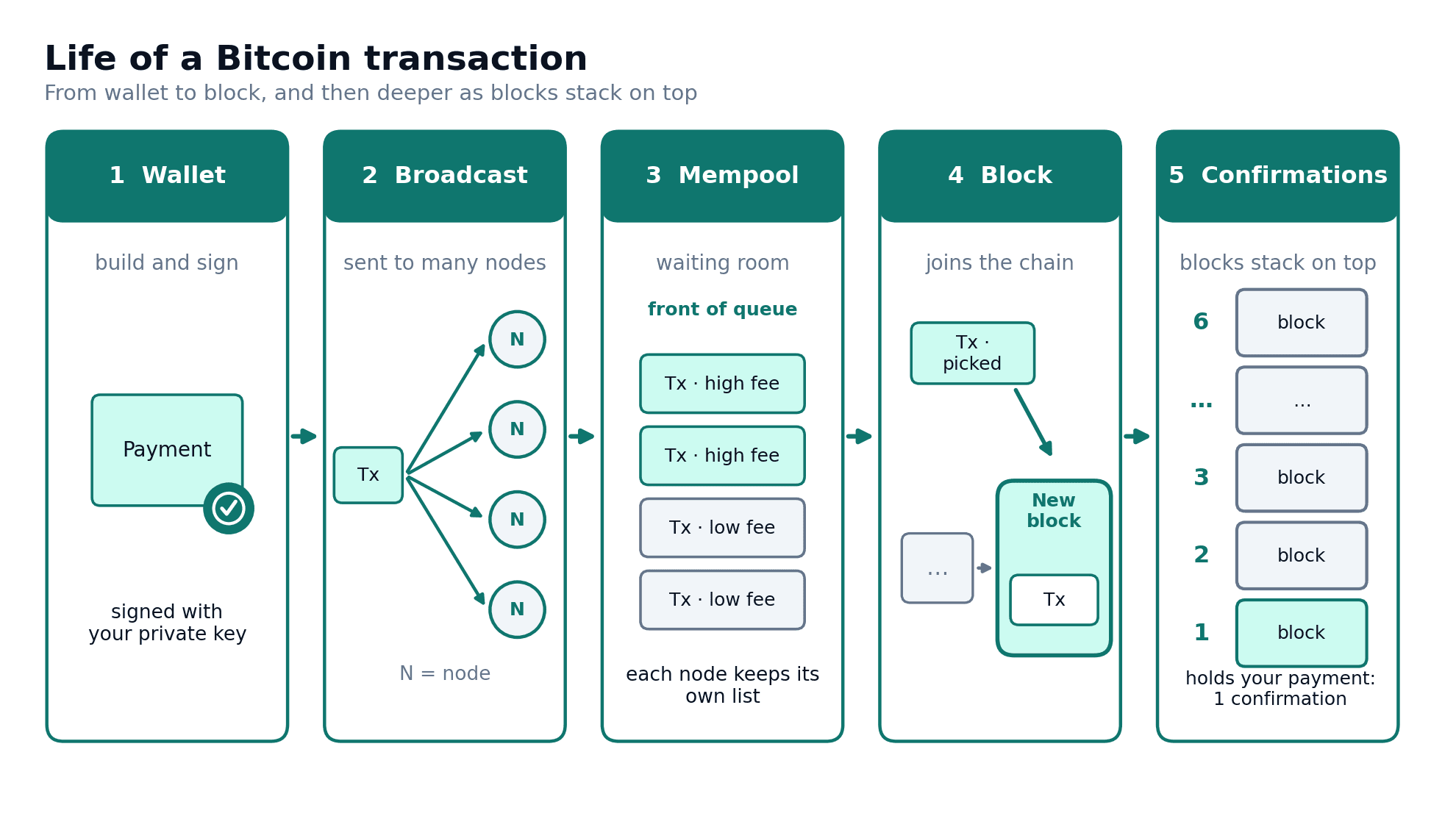
Read diagram as text
Wallet: build and sign the payment using the private key. Broadcast: send the transaction to nodes.
Mempool: each node maintains its own waiting list; the illustration contrasts higher- and lower-fee transactions without promising queue order.
Block: a miner includes the transaction in a candidate block that the network must accept. Confirmations: inclusion counts as one confirmation, with later blocks adding depth. Provider credit has separate requirements.
Section 2 of 6
Mining rewards, machines and pools
Collect the reward subsidy plus fees
The first transaction in every block, the coinbase transaction, has no inputs and pays the winning miner. The whitepaper compared this to gold miners spending resources to add gold to circulation, except that bitcoin miners spend computer time and electricity.
Block reward = block subsidy + total fees in the blockTwo safeguards apply. New coins cannot be spent for at least 100 blocks, in case their block goes stale (the shared ledger lesson in Level 1). And a miner who pays itself more than the rules allow sees the whole block rejected. The subsidy also halves on a schedule, which the supply and halving lesson in Level 1 covers. First, meet the competitors.
Follow mining from laptops to specialised machines
In 2009 bitcoin was mined on ordinary computers, hence the whitepaper's "one-CPU-one-vote". As competition grew, ordinary processors could no longer keep up. Today's miners use ASICs (application-specific integrated circuits), machines built only to run Bitcoin's hash function. The Cambridge Centre for Alternative Finance tracks more than 100 ASIC models and compares them by joules of electricity per terahash (a trillion hashes).
Even with good machines, Lena might wait years to win a block alone. So most miners join forces.
Share the luck in a mining pool
A mining pool lets miners combine work and receive payments under a stated payout method, instead of each waiting alone for an occasional block. Think of colleagues pooling lottery tickets: the pool makes individual income less erratic, while adding an organiser to trust.
Miners submit shares that satisfy an easier pool target. A share demonstrates work; occasionally one also meets Bitcoin's network target and produces a block. Payout methods differ. Some share actual rewards, while others pay an estimated amount per accepted share and shift part of the luck risk to the operator.
Read fees, eligibility and payout rules. Pool operators can influence transaction selection, and concentration matters. Individual miners can switch pools, but that does not make operator control disappear.
The subsidy is newly issued BTC under the issuance schedule. Fees come from spending transactions and do not represent additional creation beyond that subsidy. A miner earning a block reward is not evidence that an ordinary holder earns yield merely by holding BTC.
Section 3 of 6
Calculate size, fee rate and fee
Measure the fee in sat/vB
A satoshi (sat) is the smallest unit of bitcoin: 0.00000001 BTC, or one hundred-millionth. You'll learn more about it in the supply and halving lesson in Level 1. Arjun's fee of 0.000014 BTC is 1,400 sats.
Fees are priced by size, not by the amount sent. The developer guide notes that transactions pay fees based on their size in bytes. Bitcoin measures that size in virtual bytes (vB), so fee rates are quoted in satoshis per virtual byte (sat/vB). A transaction with many inputs is bigger, and so costs more, even if it moves a small amount.
Fee (sats) = transaction size (vB) × fee rate (sat/vB)| Fee rate | Fee in sats | Fee in BTC | Priority when the network is busy |
|---|---|---|---|
| 2 sat/vB | 280 | 0.0000028 | Low; may wait a long time |
| 10 sat/vB | 1,400 | 0.000014 | Middle |
| 50 sat/vB | 7,000 | 0.00007 | High; likely to be picked sooner |
Sending 0.004 BTC or 4 BTC in the same 140 vB transaction costs the same fee. What changes the right rate is how crowded the network is.
Understand why fees rise and fall
Think of a bus with a fixed number of seats. On a quiet afternoon any fare will do; at rush hour, passengers outbid each other for a place. Block space is limited in the same way, so when many people send at once, they compete on fee rate. Bitcoin Optech describes fee estimation as working out the rate needed for a good chance of confirming within a chosen number of blocks. Wallets do this for you, often offering "fast" or "slow".
Where does Fatimah's transaction wait while it hopes for a seat? In a place called the mempool.
A transaction with more inputs or a different structure can cost more at the same rate. The amount being transferred is therefore not the only determinant of cost. When demand for block space increases, a low rate may wait longer. Wallet estimates reflect changing conditions and uncertainty, not an exact delivery appointment. A recipient or exchange can also charge a separate service fee that should not be confused with the network fee. These are arithmetic examples, not recommended live fee settings.
Section 4 of 6
Confirmations and practical finality
Inclusion in the first accepted block normally gives one confirmation. Each subsequent accepted block adds another. More confirmations generally make a transaction harder to remove through a competing-work reorganisation, but no fixed count removes every theoretical or operational risk. Temporary competing tips are part of distributed operation, and rare deeper reorganisations require more careful handling.
A shop accepting a low-value purchase may use a different policy from an exchange processing a large deposit. The policy reflects the amount at risk, the system and the provider's own procedures. Do not assume that a wallet showing three confirmations means every recipient must credit immediately. The recipient may require more confirmations or additional compliance checks. Also distinguish a blockchain confirmation from a successful delivery of the goods promised in exchange.
Understand confirmation and practical finality
Bitcoin has no ordinary chargeback system for a confirmed payment. More accepted blocks above it increase the work needed for a competing valid history to remove it. That is practical, probabilistic settlement under the network's assumptions, not a promise that every theoretical reorganisation is impossible.
For a recipient, choose and apply a confirmation policy appropriate to the service. An exchange can require additional confirmations and account checks. For a sender, independently verify the destination before authorisation. A recipient's voluntary refund is a new transaction.
Section 5 of 6
Fee replacement and Lightning
An unconfirmed Bitcoin transaction may be replaceable by another transaction spending conflicting inputs under the policies of relevant nodes and miners. Replace-by-fee can help increase a fee, but its support, eligibility and effect depend on the wallet and current network policies. It is not a universal cancel button and cannot undo a confirmed transfer. Our course stops at understanding this behaviour; it does not ask you to rescue a live payment.
Lightning uses payment channels anchored to Bitcoin to support updates and routed payments without recording every payment as a separate base-layer transfer. Channel liquidity, routing, monitoring and custody arrangements create additional considerations. A custodial Lightning application adds provider risk, while an independently controlled channel has its own operational requirements. An advertised quick payment should therefore be examined for its actual route and dependencies.
Imagine opening a tab at a café in Cape Town by leaving R400 behind the counter (an invented amount for this example). With each coffee, you and the owner update a signed note of who is owed what, and you settle the final balance once at the end of the month.
Section 6 of 6
Energy, economics and cloud mining claims
Weigh the energy debate fairly
Proof of work consumes electricity through specialised computation. Environmental impact depends on electricity demand, the generation mix, hardware production and local conditions. Those are different measurements, so an electricity figure cannot by itself establish an emissions figure.
Cambridge's electricity index publishes estimates with methodological assumptions and uncertainty. Its mining-industry surveys provide additional evidence about participating firms. A survey's coverage does not automatically establish the same proportions for every miner worldwide. Always record the report date and sample before quoting a percentage.
Critics question the energy, emissions and opportunity cost required to secure the network. Supporters argue that an open settlement system can justify a resource cost and that particular operations can use otherwise stranded energy. These are arguments to assess alongside measured evidence, not reasons to treat every mining operation alike.
Compare systems carefully: a payment count may omit activity on additional layers, while a competing system's estimate may include a different boundary. You can explain the trade-off without inventing an exact universal cost per payment.
Spot cloud mining offers that are scams
Cloud mining means paying a company to "rent" mining power in its data centre in return for a share of the coins mined. The format is risky by design, because you cannot see the machines or check that they exist.
In February 2025, the US Department of Justice announced that the two founders of HashFlare, a cloud-mining service, had pleaded guilty to conspiracy to commit wire fraud. According to the department, HashFlare sold about US$577 million of mining contracts from 2015 to 2019 without the computing power to do most of the promised mining, and showed customers dashboards with made-up figures.
You now know the mining story from guessing game to scams. Time to practise.
Everyday example
Try it yourself
Try each question on paper or explain your answer aloud before opening the worked answers. This practice is for learning; it is not scored.
1. Calculate the fee for 250 vbytes at 12 sat/vbyte.
2. A deposit has two confirmations and the provider requires four. Has the provider necessarily made an error by not crediting it?
3. Can fee replacement reverse a confirmed transfer?
Compare with the worked answers
Worked answers
1. 250 multiplied by 12 equals 3,000 satoshis, or 0.00003 BTC.
2. No. It has not yet met the stated confirmation requirement. Other service checks may also apply.
3. No. Replacement concerns unconfirmed conflicting transactions under applicable policies, not reversal of accepted history.
Quick knowledge check
Try each question on paper or explain your answer aloud before opening the worked answers. This practice is for learning; it is not scored.
Does a wallet displaying sent mean a recipient has credited a deposit?
Compare with the worked answers
Worked answers
Answer. No. Broadcasting, block inclusion, required confirmations and provider crediting are separate stages.
What to remember
Key points
✓ A mempool is a local collection of waiting transactions.
✓ Size and fee rate determine the illustrated network fee.
✓ Recipient confirmation requirements can differ.
Lesson completion check
Check what you know
References and further reading
References
Bitcoin community: Bitcoin Developer Guide Block Chain ↗
Bitcoin community: Bitcoin Core Validation ↗
Bitcoin Core: Current mempool replacement policy ↗
Lightning Labs: Payment channels ↗
Bitcoin community: Bitcoin Developer Guide Transactions ↗
Bitcoin Developer Guide: Bitcoin Developer Guide — P2P Network ↗
Bitcoin.org: Bitcoin.org — Some things you need to know ↗
Bitcoin community: Bitcoin A Peer to Peer Electronic Cash System ↗