Supply, Halvings and Common Bitcoin Claims
Section 1 of 5
How issuance approaches its limit
Your learning goal
Explain issuance and the halving while separating known rules from uncertain market outcomes.
Bitcoin's issuance rules are often discussed alongside claims about its future price. Keep those subjects separate. A rule can specify the amount newly issued in a valid block, while the market still decides what people will pay. This lesson explains the supply schedule, the meaning of a halving and several common claims that sound more certain than the evidence supports.
Key idea
Keep the protocol rule, the supply estimate and the price hypothesis in separate sentences.
Education only. Crypto assets can lose substantial value or become worthless. No lesson requires buying an asset, depositing money or sharing real passwords, private keys or recovery words.
Ask where new bitcoin comes from
Earlier in the course you saw that every winning miner receives a block subsidy of newly created bitcoin, which has been 3.125 BTC since April 2024. That raises a natural question. Who decided on 3.125, and what stops someone from creating more?
Think about how a country's money supply grows. A central bank and the commercial banks it supervises can create more money when they judge the economy needs it. People can debate their decisions, but somebody is deciding.
Bitcoin has no such decision-maker. The issuance rules were written into the software Satoshi Nakamoto released in January 2009, and every full node enforces them. As the mining and fee lessons in Level 1 showed, if a miner pays itself even slightly more than the rules allow, nodes reject the whole block. Bitcoin.org describes the result: bitcoin is created at a decreasing and predictable rate.
Because the rules are public, anyone can work out how many bitcoin will ever exist. The answer is a fraction under 21 million.
Count to 21 million
The first blocks paid a subsidy of 50 BTC. Every 210,000 blocks, the subsidy halves: 50, then 25, then 12.5, and so on. Each period of 210,000 blocks is often called an era.
Add up the coins from every era and you get a total that approaches a fixed number but never passes it.
Total supply ≈ 210,000 × 50 × (1 + ½ + ¼ + ⅛ + …) = 210,000 × 50 × 2 = 21,000,000 BTCThere is a small twist. The subsidy is counted in whole satoshis, the smallest unit, so eventually halving it rounds down to zero. Trezor's guide explains that this happens at block 6,930,000, estimated to be sometime around 2140. Working the schedule through exactly, the final total comes to about 20,999,999.98 BTC, a fraction short of 21 million.
You could picture this as a book with a fixed print run, but the analogy needs one caution. Rules are software, and software can change. Bitcoin.org explains that changes only take effect if users, miners and node operators voluntarily adopt them, so raising the cap would need near-universal agreement. That is very unlikely, but the cap is a social agreement as well as code.
So if there will only ever be about 21 million bitcoin, how can millions of people use it? The answer is in how finely each coin divides.
This is a protocol description, not a forecast of economic value. A halving is triggered by block height rather than by a fixed date appointment. Calendar estimates depend on future block production. You do not need to memorise future dates to understand that the scheduled subsidy per block becomes smaller.
Section 2 of 5
Satoshis and the halving schedule
Break a bitcoin into satoshis
You met the satoshi in the transaction and fee lessons in Level 1 when counting fees. It is the smallest unit of bitcoin: 1 satoshi = 0.00000001 BTC, one hundred-millionth of a bitcoin. Bitcoin.org notes that bitcoin can be divided to 8 decimal places, and possibly further if ever needed.
Think of a pizza cut into 100 million slices. Nobody needs to buy a whole pizza; you buy the slices you want. In the same way, most people who hold bitcoin hold a fraction of one coin.
Satoshis = BTC × 100,000,000| Amount in BTC | Amount in satoshis | Where you might see it |
|---|---|---|
| 1 | 100,000,000 | A whole coin |
| 0.01 | 1,000,000 | A larger purchase |
| 0.0005 | 50,000 | A small purchase |
| 0.000014 | 1,400 | Arjun's fee in Lesson C1.4 |
| 0.00000001 | 1 | The smallest unit |
Divisibility explains how a limited supply can be shared. Next, see how quickly it is released.
Follow the halving schedule
Imagine a fountain that pours at a set rate, then halves its flow every four years. It never stops completely within your lifetime, but the stream becomes thinner and thinner. Bitcoin's issuance works like that.
| Era | Starts at block | When it began | Subsidy per block | New BTC issued in the era |
|---|---|---|---|---|
| 1 | 0 | January 2009 | 50 BTC | 10,500,000 |
| 2 | 210,000 | November 2012 | 25 BTC | 5,250,000 |
| 3 | 420,000 | July 2016 | 12.5 BTC | 2,625,000 |
| 4 | 630,000 | May 2020 | 6.25 BTC | 1,312,500 |
| 5 | 840,000 | April 2024 | 3.125 BTC | 656,250 |
| 6 | 1,050,000 | Expected around 2028 | 1.5625 BTC | 328,125 |
Notice that the halving is set by block height, not by the calendar. That is why every date for a future halving comes with the word "about".
See why every four years is only approximate
At about 10 minutes per block, 210,000 blocks should take roughly four years.
Time per era ≈ 210,000 blocks × 10 minutes ≈ 2,100,000 minutes ≈ 4 yearsAs the mining and fee lessons in Level 1 explained, blocks sometimes arrive faster than 10 minutes when new mining power joins, and difficulty only catches up every 2,016 blocks. So eras can run slightly short or long. Kraken's history notes that the exact date of the next halving cannot be pinpointed in advance; it is expected around 2028, at block 1,050,000.
Whatever the exact date, the effect on new supply is precise, and you can measure it.
Watch new supply shrink
About 144 blocks are found in an average day (24 hours × 6 blocks an hour). Multiply by the subsidy, and you get roughly how many new bitcoin enter circulation each day.
New BTC per day ≈ 144 blocks × subsidy per blockYou can also measure how much of the total already exists. By block 840,000 in April 2024, the first four eras had issued 10,500,000 + 5,250,000 + 2,625,000 + 1,312,500 = 19,687,500 BTC. That is 93.75% of 21 million. The remaining 6.25% will trickle out over more than a century.
Halvings clearly matter to miners. The question that attracts the most hype is what they change for everyone else.
Existing supply is BTC already issued under the rules. A reduction in new issuance does not mean half the existing BTC disappears. At a halving, a holder's 0.01 BTC does not automatically become 0.005 BTC. The rule changes the permitted new subsidy, not everyone's balance. Coins may be inaccessible because signing material was lost, but proving all such losses is difficult. A dormant address is not automatically a lost address. The protocol's issuance rule and an analyst's estimate of economically available supply answer different questions.
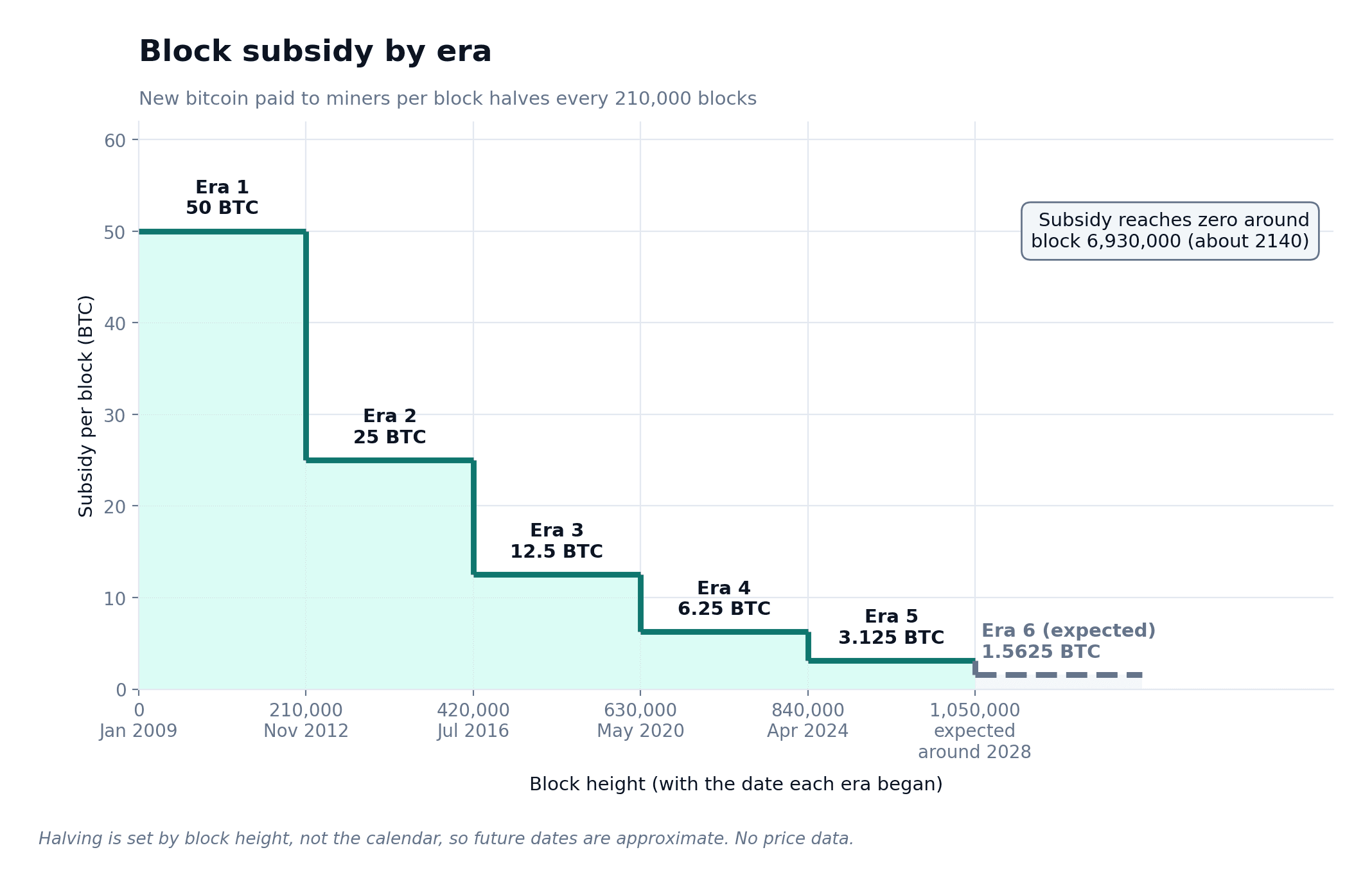
Read diagram as text
Block heights and subsidy per block: 0 → 50 BTC; 210,000 → 25; 420,000 → 12.5; 630,000 → 6.25; 840,000 → 3.125; 1,050,000 → 1.5625.
The first five eras began in January 2009, November 2012, July 2016, May 2020 and April 2024. The next calendar estimate shown is around 2028.
The note places zero subsidy around block 6,930,000, approximately 2140. Halving follows block height; future dates are estimates and no price information is shown.
Section 3 of 5
Halvings and price claims
Past subsidy reductions provide useful history about the network's rules and miner incentives. Market prices around those events also reflect demand, liquidity, broader economic conditions and expectations formed before the event. A chart showing a later price rise cannot isolate the halving as the sole cause, and selecting only favourable periods creates a misleading sample.
Claims such as a halving always leads to a specific return ignore both uncertainty and the small number of past events. A widely known event may be anticipated by market participants. Other conditions may dominate it. Treat historical patterns as observations to investigate, using a stated period and comparison, rather than as promises. Later research lessons explain how to avoid selecting evidence after seeing the result.
Separate a valid fact from an unsupported conclusion
| Statement | What it establishes | What it does not establish |
|---|---|---|
| Subsidy halves at a block interval | Rule for new permitted issuance | An exact future calendar time |
| Supply approaches a protocol limit | Constraint under current consensus rules | Guaranteed purchasing power |
| An address has not moved funds | Observed inactivity | Proof the owner lost the key |
| A past event preceded a price rise | Historical sequence | Sole cause or future return |
| A token represents BTC elsewhere | A product claim to investigate | Identical custody and network risk |
Section 4 of 5
Lost coins, scarcity and demand
A limited supply can matter, but scarcity alone does not create value. A one-of-a-kind broken chair is scarce and may have little demand. For an asset, people must be willing and able to use, hold or exchange it. Market depth determines how much can be sold near a quoted price, and the quote can change as orders arrive.
Distinguish a reason to study an asset from a reason to expect a return at a particular price. A useful network could already be valued optimistically, while a low unit price could hide a large total supply. Bitcoin's supply rules are one input into analysis, alongside demand, security, liquidity, custody and legal conditions. A complete explanation should state what the supply fact establishes and what additional evidence the price claim needs.
Imagine banknotes sealed in a jar and buried in a garden that has since been built over. The notes still exist, and the central bank still counts them as issued, but nobody will ever spend them.
Section 5 of 5
The future security budget and separate representations
A change in rules can produce a different network if participants follow incompatible histories or conditions. Assets on different chains may have related histories yet different security, users and market prices. A similar name or ticker does not make them the same BTC asset. Always identify the network and actual product rather than relying on branding.
Wrapped representations of BTC on other networks introduce additional mechanisms such as custody, issuance or bridge arrangements. A representation may aim to track BTC's value while relying on an issuer or contract that native BTC does not require in the same way. Redemption may be restricted, suspended or fail. A claim labelled Bitcoin exposure can also be an exchange balance or a fund share. We will revisit these dependencies in bridges and institutional products.
Everyday example
Try it yourself
Try each question on paper or explain your answer aloud before opening the worked answers. This practice is for learning; it is not scored.
1. If a subsidy falls from an illustrative 6.25 BTC to 3.125 BTC, what happens to a holder with 0.02 BTC?
2. Why should a dormant-address supply estimate state its assumptions?
3. Name two facts needed before treating a wrapped token as equivalent to native BTC.
Compare with the worked answers
Worked answers
1. The holding remains 0.02 BTC. The new subsidy per valid block changes; existing quantities are not halved.
2. Dormancy does not prove loss. The estimate depends on classifications that can be uncertain or revised.
3. Identify custody or bridge mechanisms, redemption rights and restrictions, contract identity, network and failure procedures. Price tracking alone is insufficient.
Quick knowledge check
Try each question on paper or explain your answer aloud before opening the worked answers. This practice is for learning; it is not scored.
Does a fixed supply guarantee a positive investment return?
Compare with the worked answers
Worked answers
Answer. No. Returns depend on the purchase price, later demand, liquidity, costs and the asset remaining usable.
What to remember
Key points
✓ Halvings reduce permitted new subsidy at defined block heights.
✓ Inactivity and permanent loss are different claims.
✓ Scarcity is one economic factor rather than a price guarantee.
Lesson completion check
Check what you know
References and further reading
References
Bitcoin community: Bitcoin Developer Guide Block Chain ↗
Bitcoin community: Bitcoin FAQ ↗
Ethereum: Introduction to blockchain bridges ↗
SEC Investor.gov: Crypto Asset Custody Basics for Retail Investors ↗
Bitcoin community: Bitcoin A Peer to Peer Electronic Cash System ↗
Bitcoin community: Bitcoin Core Validation ↗
CFTC: Understand the Risks of Virtual Currency Trading ↗
Bitcoin Developer Documentation: Bitcoin Developer Documentation — Glossary ↗
Bitcoin community: Bitcoin Developer Guide Transactions ↗
Bitcoin Developer Guide: Bitcoin Developer Guide — Wallets ↗
End of Level 1
You've finished the lessons in this level. Review what you learned before continuing.