Start Here and Understand Cryptocurrency
Section 1 of 5
Money you already use
Your learning goal
Explain cryptocurrency in ordinary language and identify realistic reasons to study it.
You can learn about cryptocurrency without buying it. Start with a question you already understand: when money moves, who keeps the record, and how do other people know that the record is right? This course follows that question from everyday payments to Bitcoin, wallets, markets and applications. You will also learn how things fail. Understanding a system includes knowing which promises it can keep, which people or services you still depend on, and which mistakes may be difficult to reverse.
Key idea
Ask who keeps the record, who can authorise a change and who can help if something goes wrong.
Education only. Crypto assets can lose substantial value or become worthless. No lesson requires buying an asset, depositing money or sharing real passwords, private keys or recovery words.
Start with the money you already use
Before talking about crypto, think about the money that passes through your hands each week. Priya, a teacher in Pune, has three kinds. She has a few rupee notes in her purse. She has a salary in her bank account. And she has a payments app she uses to pay the vegetable seller ₹200 (an invented amount for this example).
All three feel like "money", yet they differ. The notes are physical objects. Her bank balance is not a pile of notes with her name on it; it is a number in the bank's records, a promise that the bank owes her that amount. Her payments app works the same way, with a company keeping the number.
So most money is already digital: entries in someone's record book. Crypto is also a record. The big difference is who keeps it.
Ask who keeps the record
A balance is a record about value and rights. Your bank maintains the record for a deposit; a payment firm maintains its service balance under its own terms. Changing the number on your own screen would not change what either provider owes.
Now imagine a savings group in Mumbai. If only one person keeps the notebook, everyone relies on that person's honesty, availability and corrections. Sharing copies makes changes easier to inspect, but the group still needs rules for accepting a new entry and resolving disagreement.
A blockchain adds software rules and a method for agreeing on accepted activity. It does not automatically make the recorded asset valuable or the people using it honest. The first useful question is who keeps the record; the next is what authority and rights that record actually gives you.
Compare crypto with cash, bank and mobile money
Cash, bank deposits, payment-app balances and crypto can all appear to do the same everyday job: help you pay someone. The arrangements behind them differ.
| Form | Who or what maintains the record | What you control | Reversal and protection questions |
|---|---|---|---|
| Physical cash | Issuer and physical possession | Notes or coins in your possession | Handing it over has no routine digital undo; possession does not settle every legal ownership dispute |
| Bank deposit | Bank under applicable law | A claim on the bank accessed through its account system | Error procedures and eligible deposit protection depend on country and account |
| Payment-app balance | Bank, payment firm or e-money issuer under its terms | A service balance or claim | Safeguarding, refunds and protection vary by provider and jurisdiction |
| Native bitcoin in self-custody | Bitcoin's accepted ledger and spending rules | Signing authority over relevant outputs | No general bank-style reversal; price and access risks remain |
| Other crypto token | Its network and token rules | The authority or claim defined by that arrangement | An issuer or administrator may have powers; insurance is not automatic |
When you pay a shop, the banking system changes account records rather than moving a particular banknote across the country. Other networks may track account balances or run programs. The ledger analogy helps explain records; it does not mean that a blockchain has the same permissions, refund process or legal protections as a family spreadsheet or a bank.
Section 2 of 5
A shared record and decentralisation
So what is a cryptocurrency
Imagine neighbours keeping a shared list of who paid for a community garden. Instead of one neighbour owning the only copy, several keep copies and use agreed rules to check new entries. A distributed ledger uses a related idea, although its software and security rules are far more exact than a neighbourhood list.
Cryptography helps check data and authorise actions. In a typical self-custody arrangement, private signing material lets the holder approve spending, while public information lets other participants verify that approval. A provider account can work differently: you log in to the provider and ask it to act using keys it controls.
A blockchain groups accepted activity into blocks linked by cryptographic references. The network's rules determine which activity is valid and how participants select an accepted history. The word crypto does not tell you whether one company can freeze a token, whether an application can be upgraded, or whether a deposit is insured. Those questions belong to the particular asset and service.
Understand decentralised without the jargon
Compare two ways of running a football league table. In one, the league office keeps the official table. In the other, every club keeps a copy, and a result counts only when most clubs agree it followed the rules. The second league has no head office that can change a score alone.
Bitcoin.org compares this to email: nobody owns the Bitcoin network, much as nobody owns the technology behind email. An individual company does not ordinarily control the entire Bitcoin ledger. Particular gateways, miners, networks or services can still restrict access, and continued operation depends on the network functioning.
The matching risk matters as much. If no one is in charge, there is often no one to call: no help desk, no manager to cancel a mistaken payment, no built-in compensation fund. And because most people use crypto through companies such as exchanges, you often trust a company again, sometimes without the protections you are used to (the loss and safety lesson in Level 0 and Level 3).
Now put the four kinds of money side by side.
A system may distribute one of these activities while concentrating another. Shared software does not remove people. Different arrangements make different trade-offs in speed, cost, privacy and control. Rather than accepting a label such as decentralised or trustless, identify the specific party or rule you rely on.
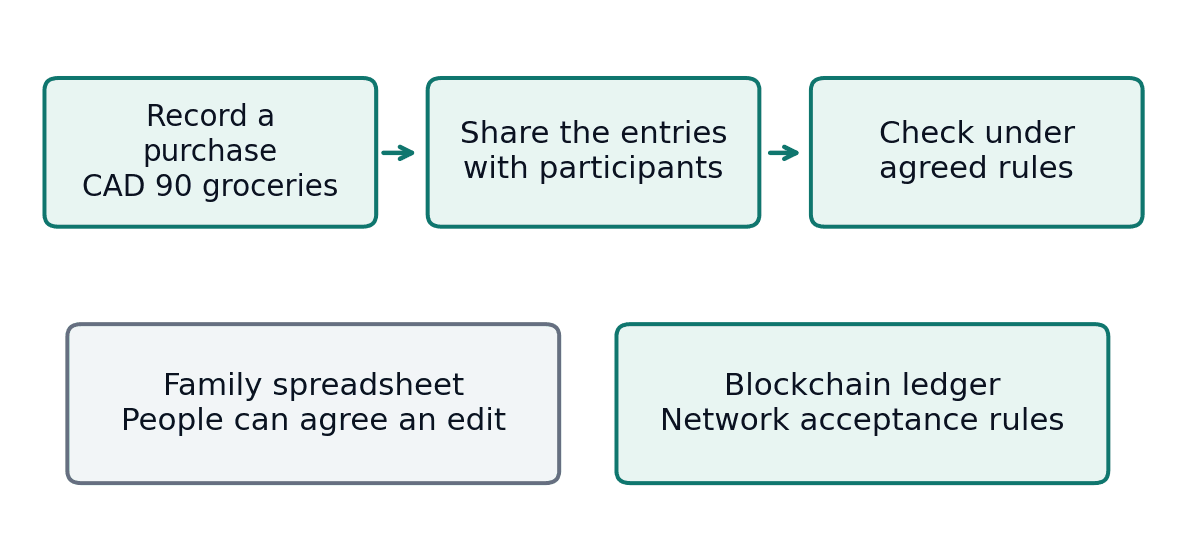
Read diagram as text
Start with the example purchase: CAD 90 of groceries. Record it, share the entries with participants, then check them under agreed rules.
The lower boxes distinguish a family spreadsheet, where people can agree an edit, from a blockchain ledger, where network acceptance rules apply.
Section 3 of 5
Origins, families and central bank digital money
See where crypto came from
In 2008 the world was in a financial crisis. Large banks failed or needed rescue, and many people lost trust in the institutions holding their money. In October 2008 someone using the name Satoshi Nakamoto published a short paper, "Bitcoin: A Peer-to-Peer Electronic Cash System". It described a way to send value online directly between people, without a bank in the middle.
In January 2009 the Bitcoin software was released and the network began running. Bitcoin.org notes that Satoshi left the project in late 2010 without revealing much about himself. The name is a pseudonym, and the real identity is still unknown. Level 1 tells the full story, including earlier attempts at digital cash.
Bitcoin was the first working cryptocurrency, but not the last. Developers copied and changed the idea, and price sites now list many thousands of coins and tokens, while many others have vanished. No single person invented "crypto" as a whole.
Bitcoin's central design goal, working without a bank in the middle, has a name you will hear constantly: decentralisation.
Know the main families of crypto
Open a crypto price website and you will see a long list of names. Most fall into a few families. This lesson only names them; later levels teach each one.
Bitcoin (BTC) is the first cryptocurrency, launched in 2009, and is used mostly to hold and send value (Level 1). Platform coins belong to networks that can run programs on the shared record; the best known is ether (ETH) on Ethereum (Level 4). Stablecoins are tokens that aim to keep a steady value, often one US dollar; they are not bank deposits and their steadiness is not assured (Level 3). Other tokens cover the rest: app tokens, voting tokens, meme coins and more (Level 5).
The word "digital" can also mislead, because governments are working on digital money too.
Tell crypto apart from central bank digital money
A central bank digital currency, or CBDC, is digital money issued as a central-bank liability under its design. A retail CBDC would be intended for ordinary users; a wholesale version is intended for defined financial-market participants. A bank-account balance is already digital, but it is normally a commercial-bank liability, so digital does not mean CBDC.
Bitcoin has no central-bank issuer. A privately issued stablecoin instead aims to track a reference value through its reserves, collateral or another mechanism. These are separate arrangements even when they appear in wallet-shaped applications.
CBDC projects range from research and pilots to launched systems. Check the relevant central bank's current publication before describing a country's status. A pilot announcement is not proof that a product is available to everyone.
Section 4 of 5
Useful possibilities and realistic limits
Crypto assets can lose substantial value, and some can become worthless. Access can also be lost through theft, a failed provider, an incorrect transfer or a lost key. These risks are separate from whether the underlying technology is interesting. Regulators emphasise that protections vary by product, provider and country. A familiar brand, a professional website or a large online following does not establish that an activity is protected.
For this course, use fictional balances and supplied examples. Never include real passwords, recovery words or private keys in an assignment. Later lessons introduce tools that illustrate arithmetic under stated assumptions. Their outputs are learning aids rather than instructions to trade. A useful beginner goal is to explain a product, identify the dependencies, and calculate an example correctly. You do not need to predict the next price move to meet that goal.
Section 5 of 5
Local checks and the learning journey
Level 0 builds orientation and safety. Levels 1 and 2 explain Bitcoin and wallet security before any transfer exercise. Level 3 introduces exchanges and spot markets. Levels 4 to 6 explain Ethereum, token research and decentralised finance. Level 7 develops careful analysis, and Level 8 connects position size, portfolio concentration and record keeping. Level 9 teaches research practice and decision habits. Level 10 brings the parts together in a graduation dossier.
Read a lesson in order on your first visit. After a teaching section, stop and explain the idea aloud using an ordinary example. Work through the supplied practice before reading the answer. If your explanation relies on a word you cannot define, return to that section or the glossary. The level quiz then checks several ideas together. A wrong answer is useful information about what to revisit; it is not a reason to rush ahead.
Check the legal status where you live
Legal status is a question about an activity, a product, a provider and a place. A country may permit holding an asset while restricting its use for payments, the promotion of investment products, or access to leveraged trading. Tax duties can also exist even when an activity is unregulated.
Use your central bank, financial regulator and tax authority as separate starting points. Compare the exact legal entity in a provider's terms with an official register. Record the date and the permission's scope. A licence for one service is not approval of every token, and a foreign licence does not establish permission to serve you locally.
This course uses historical regulatory examples to teach a checking method. It cannot turn one country's rule into a global answer. If a notice is a proposal, consultation or pilot, describe it that way. Before an actual decision, obtain the current official guidance relevant to your residence and activity.
Everyday example
Try it yourself
Try each question on paper or explain your answer aloud before opening the worked answers. This practice is for learning; it is not scored.
1. Write one question about technology and one about markets that you want this course to answer.
2. Choose a practice activity that needs no money.
3. In the grocery example, explain one similarity and one difference between a spreadsheet and a blockchain.
Compare with the worked answers
Worked answers
1. A technology question could ask how a transaction is validated; a market question could ask how an order book produces an execution price. They require different evidence.
2. Reading a public explorer or calculating a fictional order is sufficient. No wallet funding is necessary.
3. Both record entries. The family can agree to edit its spreadsheet; a blockchain follows network rules for accepting history and cannot promise the same correction process.
Quick knowledge check
Try each question on paper or explain your answer aloud before opening the worked answers. This practice is for learning; it is not scored.
Does completing a blockchain course prove that a learner can predict market prices?
Compare with the worked answers
Worked answers
Answer. No. Technical understanding and price forecasting are different skills. The course assesses understanding, risk awareness and the quality of practice.
What to remember
Key points
✓ A ledger records entries; a blockchain is one method of maintaining a ledger.
✓ Control must be examined function by function.
✓ Learning can remain entirely separate from holding or trading.
Lesson completion check
Check what you know
References and further reading
References
MIT OpenCourseWare: Blockchain and Money ↗
NIST: Blockchain Technology Overview NISTIR 8202 ↗
SEC Investor.gov: Crypto Asset Custody Basics for Retail Investors ↗
Bitcoin community: Bitcoin FAQ ↗
Bank of England: Bank of England — The digital pound ↗
ESMA: ESMA — Markets in Crypto-Assets Regulation (MiCA) ↗
FCA: Qualifying retail crypto ETNs and continuing restrictions ↗