Understand the Different Ways Money Can Be Lost
Section 1 of 5
Price falls and recovery arithmetic
Your learning goal
Recognise price risk, access risk and operational risk before considering any exposure.
When someone says they lost money in crypto, ask how the loss happened. A falling price, a stolen key and an insolvent exchange can all reduce a person's wealth, but they are different failures. Each calls for different precautions. This lesson turns a vague warning about risk into a practical map you can use throughout the course.
Key idea
Name the failure mechanism before selecting a safety measure.
Education only. Crypto assets can lose substantial value or become worthless. No lesson requires buying an asset, depositing money or sharing real passwords, private keys or recovery words.
Feel how volatile crypto can be
Volatility describes how far and how fast a price moves. A savings account barely moves. Crypto can move more in a day than many shares move in a year.
A real example shows the scale. In November 2022, CNBC reported that bitcoin had peaked at more than US$68,000 a year earlier and was trading below US$18,000. Bitcoin fell roughly 75% from its November 2021 high to its November 2022 low. Over the same period the whole crypto market, once valued at roughly US$3 trillion, fell to around US$900 billion.
The US Commodity Futures Trading Commission (CFTC) notes that virtual currencies are more volatile than traditional currencies, and warns of sudden price swings and "flash crashes". None of this tells you what prices will do next. It tells you what they have done, which is enough to plan for.
Do the recovery arithmetic
Losses and gains are not symmetrical. If something falls by half, a 50% rise only takes it back to three-quarters of where it started. To return to the start, it must double.
Gain needed to recover = L ÷ (1 − L), where L is the loss as a decimal.| Fall | Gain needed to get back to the start |
|---|---|
| 10% | about 11% |
| 25% | about 33% |
| 50% | 100% |
| 75% | 300% |
| 90% | 900% |
So Ji-woo's ₩250,000 would need to quadruple to reach ₩1,000,000 again. There is no rule saying it ever will; many coins never recover.
Big falls hurt more when you watch them hour by hour, and crypto markets commonly continue around the clock.
Selling realises the trading result under the applicable accounting rules, but leaving the holding unsold does not remove the economic loss or guarantee recovery. A price may recover, remain low or fall further. A plan based solely on waiting until the price returns to your purchase price may never be completed. The purchase price matters for your records, but buyers in the current market are not obliged to restore it.
Section 2 of 5
Access mistakes, theft and permanent loss
Access risk concerns the ability to control or retrieve assets. A lost recovery method may leave a self-custody wallet inaccessible. A leaked key may let another person transfer assets. A frozen provider account or an exchange failure may block withdrawals. Operational mistakes include selecting an unsupported network, omitting a required memo, or signing a harmful transaction. The ledger may function exactly as designed while the user suffers a loss.
Other failures involve the asset or application itself. A stablecoin can depart from its target price, a contract can be exploited, and a bridge can fail. These failures can occur while a user's own key remains secure. A strong password addresses one problem; it cannot repair an underfunded issuer or a vulnerable contract. Later lessons teach specific checks for each activity. For now, describe the failure mechanism before choosing a precaution.
Guard against mistakes and lost access
A valid address can still be the wrong destination. Many address formats include checksums that detect typing errors, so a one-character typo may be rejected. A checksum cannot tell that a correctly formed address belongs to an attacker rather than your friend.
Lost signing material creates a different problem. If no usable backup or recovery arrangement remains, a ledger holding may still exist while nobody can authorise spending. If someone copies usable signing material, both people may be able to act. Changing an app password does not revoke the copied key.
Levels 2 and 3 teach the practical distinctions: asset identity, networks, memos, backups, permissions and provider records. Avoid guessing which remedy fits before identifying the failure.
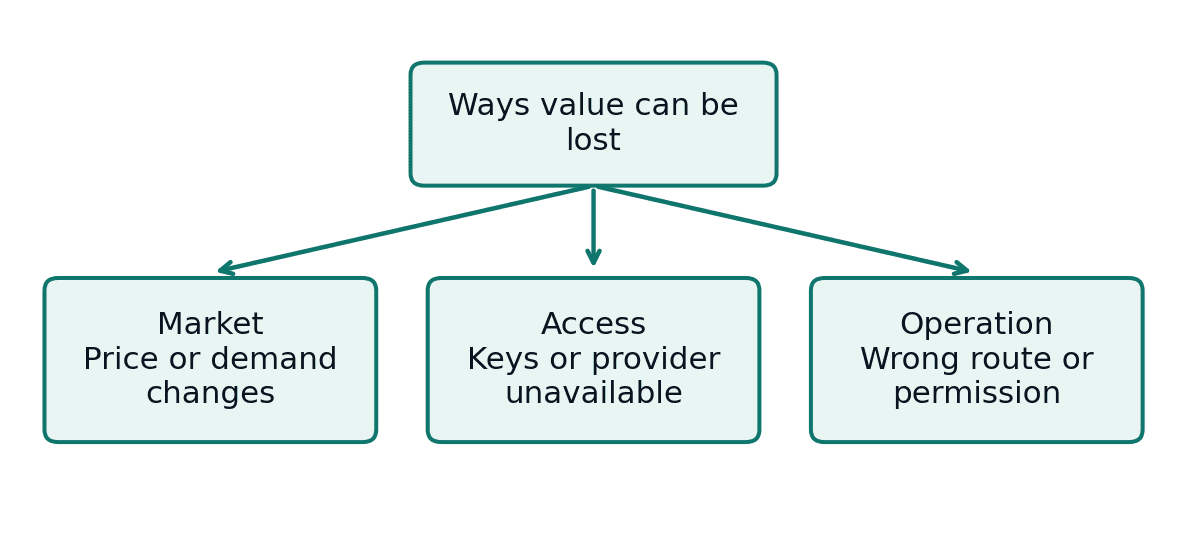
Read diagram as text
Market: price or demand changes.
Access: keys or a provider become unavailable.
Operation: the wrong route or permission causes loss. These branches identify different mechanisms, not mutually exclusive guarantees.
Section 3 of 5
Money for everyday needs comes first
The US Consumer Financial Protection Bureau describes an emergency fund as cash set aside for unplanned expenses or financial emergencies. Without one, a surprise bill can push you into debt. It belongs in a safe, accessible place such as a bank or credit union account.
The order matters. Emergency fund first; any crypto later, and only with money you can afford to lose completely. The CFTC advises speculating only with money you can afford to lose. Australia's ASIC Moneysmart says that if a crypto-asset fails, you will most likely lose all the money you put in. A 2023 SEC investor alert also suggests paying off high-interest debt before speculative investments. The UK FCA's message is "be prepared to lose all your money".
Realistic expectations follow from this. Nobody can promise you a return in crypto. Some people have made money; many have lost it. The CFTC states plainly that no investment or trading strategy comes with a guarantee. If you hear otherwise, you are probably hearing a sales pitch, or a scam, which the scam and learning routine lesson in Level 0 covers.
Now put these ideas into practice.
Food, rent, school costs, debt payments and emergency needs do not become less important because a market looks exciting. Money that must be available next month cannot safely be treated as a long-term experiment that might become inaccessible. A loss budget is an amount whose loss would not disrupt the needs and obligations it is meant to respect. This course does not prescribe a percentage of your income or savings to invest. People have different obligations, income stability and local protections.
Section 4 of 5
What borrowing adds to a loss
Borrowed money introduces an obligation that can survive a failed investment. A person who borrows GBP 500 to buy an asset still owes the lender if the asset becomes worthless. Trading with leverage also changes the relationship between the position's size and the funds supporting it. Adverse movement can trigger liquidation under contract rules before the learner expects it.
Leverage is often advertised through possible gains. Examine the loss mechanism with the same arithmetic. A small percentage move on a large position can consume a substantial part of the supporting margin, and fees or funding add costs. We will calculate these relationships at Level 8. At this stage, identify borrowing and leverage as additional obligations rather than a shortcut around a small budget. A beginner practice exercise does not require either.
Section 5 of 5
Match each precaution to its risk
Diversifying holdings may reduce concentration in one asset, but it does not restore a lost wallet key. A test transfer may reveal that a route currently works, but it does not prove that the next transaction is correctly addressed. A stop order can be triggered without filling at the desired price, and it cannot force a failed exchange to reopen. Precautions have specific jobs and limits.
Build layered protection: understand the asset, protect access, check the service, inspect each action and limit affordable exposure. Record the assumptions you cannot verify. An unresolved risk can be a reason to stop an activity even when other checks look good. This is a practical skill rather than pessimism: the learner who identifies the actual failure mechanism can choose a relevant response instead of relying on one reassuring feature.
Think about the last time a payment went wrong for you. Perhaps a shop charged you twice, or a card was used by someone else. In many countries you could call your bank, explain, and after some forms the money came back. That ability to undo is so normal that most people never notice it.
See why a crypto transfer usually cannot be reversed
A refund in everyday life usually depends on someone with authority and a process: the shop, a bank or a payment provider. A confirmed native Bitcoin transfer has no general customer-service reversal procedure. The recipient can voluntarily make a new return payment, but that is different from the sender cancelling the first one.
Other crypto systems can have issuer freeze powers, administrator interventions or recovery arrangements. Recent blocks can also be affected by reorganisations under a network's consensus rules. These possibilities do not give an ordinary sender a reliable undo button.
Build the “test small, check twice” habit
Build a pre-send routine around the asset, network, destination, memo or tag, recipient minimum, amount and fee. Obtain the instructions independently and inspect the final request, including the trusted device display where available. If you cannot understand the action, pause.
A valid small test may help check the route. Wait for the expected recipient credit, then repeat the checks for the actual transfer. Do not send a duplicate just because a display is slow. Identify whether the first action is pending, confirmed or awaiting service processing.
Everyday example
Try it yourself
Try each question on paper or explain your answer aloud before opening the worked answers. This practice is for learning; it is not scored.
1. Calculate the percentage fall from GBP 100 to GBP 60.
2. Which risk is addressed by a backup of recovery material? Which is not?
3. An exchange is unavailable during a price fall. Identify two simultaneous risks.
Compare with the worked answers
Worked answers
1. The loss is GBP 40 divided by GBP 100, or 40 percent. Returning from GBP 60 to GBP 100 would require a 66.67 percent gain on the smaller balance.
2. A secure usable backup addresses loss of access. It does not prevent a market fall and does not make an exposed secret safe.
3. The learner faces market movement and provider or operational unavailability. A sell instruction may not be executable during the outage.
Quick knowledge check
Try each question on paper or explain your answer aloud before opening the worked answers. This practice is for learning; it is not scored.
Can a stop order protect assets from a leaked recovery phrase?
Compare with the worked answers
Worked answers
Answer. No. A stop order concerns trade execution. Recovery material concerns signing authority, and a thief may bypass the venue where the stop exists.
What to remember
Key points
✓ Different loss mechanisms need different precautions.
✓ An unsold loss is still a reduction in current value.
✓ An affordability boundary should be decided before market pressure arrives.
Lesson completion check
Check what you know
References and further reading
References
CFTC: Understand the Risks of Virtual Currency Trading ↗
SEC Investor.gov: Crypto Asset Custody Basics for Retail Investors ↗
ethereum.org: ethereum.org — Networks (testnets, faucets) ↗
Ledger Academy: Ledger Academy — Etherscan: What It Is and How to Use It ↗
Bitcoin.org: Bitcoin.org — Some things you need to know ↗
Federal Trade Commission: Federal Trade Commission — What To Know About Cryptocurrency and Scams ↗
Coinbase Help: Coinbase Help — Crypto sent to the wrong address ↗